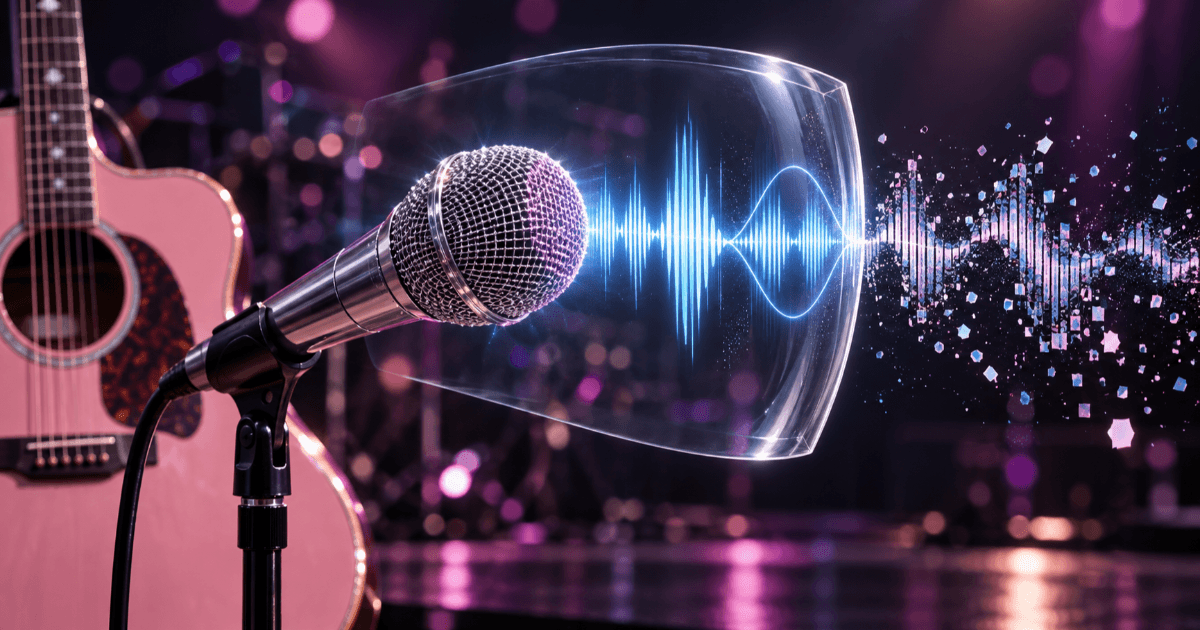
Taylor Swift Expands Trademark Applications for "Voice"—How to Protect Authenticity in the AI Era
A familiar voice speaks to you, introducing new songs, recommending products, or calling for support on certain issues.
In the past, many would have accepted that voice as genuine. However, as generative AI makes voice imitation easier, the gap between "sounding like the person" and "the person actually speaking" widens.
The trademark applications by Taylor Swift's rights management company, TAS Rights Management, are gaining attention as a response to this issue.
According to music industry media Music Business Worldwide, reported on October 14, 2026, the company has applied for trademarks related to Swift's speaking voice in the UK, European Union (EU), and Australia. In the UK and EU, they have also applied for trademarks concerning photos of Swift on stage.
However, it is premature to interpret this news as "Taylor can now fully monopolize her voice." Application and registration are different, and even if registered, the extent of protection remains an issue.
Under Review in the UK and EU, Not Yet Registered in Australia
Prior to this move, TAS Rights Management filed three trademark applications in the US on April 24.
The applications covered recordings of Swift saying "Hey, it’s Taylor" and "Hey, it’s Taylor Swift," as well as a photo of her on stage with a pink guitar.
According to MBW, on October 6, applications concerning Swift's voice saying "Hey, it’s Taylor Swift" were filed in the UK, EU, and Australia. On the following day, applications related to photos were filed in the UK and EU.
As of the report on October 14, the applications in the UK and EU were under review. Although the sound trademark in Australia was accepted and announced on October 12, it was still in the opposition period before registration.
According to IP Australia's explanation, trademarks that pass examination are announced, and for two months after, third parties can oppose the registration.
Thus, news of "passing examination" and "rights being finally registered" should be read separately. Moreover, mere application does not make all AI imitations illegal.
Why "Trademark" and Not Just Copyright for Songs?
What makes this application interesting is that it seeks to protect more than just the songs themselves.
The act of reproducing an existing recording as is and the act of making someone sound like they are saying new words with a similar voice are not the same. AI imitation can create content that "feels like the person is speaking" without using the exact original recording.
This creates issues that cannot be fully addressed by protecting recorded works alone.
For example, imagine a video where a voice that sounds just like the person endorses a product they have not approved. The issue is not just the voice copy but also the potential for viewers to mistakenly believe "it's the person's advertisement" or "the person is collaborating."
Trademarks are a system to identify who provides a product or service. The US Patent and Trademark Office also explains that the central factors in determining trademark infringement are the similarity of the marks, the relatedness of the goods or services, and the likelihood of confusion about the source.
Swift's applications can be seen as an attempt to use this system to protect "authenticity" through voice and appearance.
It Doesn't Mean "All Similar Voices Are Prohibited"
Intellectual property attorney Josh Gerben, who first discovered the US applications, points out that registering specific voice phrases could potentially counter not only exact reproductions but also imitations that cause confusion.
On the other hand, as MBW introduced, Gerben explains that the method of attempting to trademark a celebrity's speaking voice is a new endeavor that has not been thoroughly tested in court.
There is both expectation and uncertainty here.
If a voice similar to the person is used, how similar is it to the registered trademark? What products or services is it used for? Is it used in a way that misleads people into thinking the person is providing or endorsing it? What are the laws in the applicable country or region?
Without considering these circumstances, one cannot definitively say, "It's always infringement because it's similar," or "It's always legal if the phrase is changed."
Additionally, according to MBW, the applications in Australia and the EU are filed under International Class 41, which deals with services like entertainment. The designated services in Australia include providing information in the music and entertainment fields and websites offering non-downloadable recordings about music artists.
This indicates that the applications are tied to specific services and should not be equated with a right to own the "voice quality itself in all situations."
Support on Social Media and Questions About "What About Ordinary People?"
What are people saying on social media about this issue?
What was confirmed this time were reactions mainly to a Reddit post about the US applications in April. It is necessary to distinguish these from reactions to the expansion of overseas applications in October. The following is a summary of the post content and does not represent the entire public opinion.
One prominent point was support for actions to protect oneself from unauthorized AI use. Opinions suggested that other singers and actors should consider measures and that clear permission from the person is important.
At the same time, questions arose about whether it is acceptable for only celebrities to secure protection at a cost, given that protecting voice and appearance is necessary for everyone. Concerns were expressed about whether ordinary people can claim rights in the same way and bear the costs of litigation.
There were also posts worrying about the impact on people whose voices accidentally resemble others and posts hoping that actions by well-funded celebrities would lead to future protection.
These reactions highlight the coexistence of a desire to "protect the person" and questions about "the scope and accessibility of protection."
Japan Also Has Sound Trademarks, But It Doesn't Lead to the Same Conclusion
For Japanese readers, this issue is not a distant world event.
Since April 2015, it has been possible to apply for "new types of trademarks" that include sound in Japan. A system to protect sound as a brand marker already exists.
However, not all recorded sounds can be registered. The Japan Patent Office indicates that a distinguishing power, or "distinctiveness," to differentiate one's goods or services from others is necessary.
Just because a famous singer has applied for a voice trademark overseas does not mean that the entire voice can be comprehensively protected in Japan. Japan is not included in the overseas applications reported in this article.
Nevertheless, Japan has many people such as singers, voice actors, narrators, and streamers, for whom voice is a significant part of their activities. If advertisements or guides mimicking their voice spread, it could affect not only trust in the person but also job opportunities and relationships with fans.
In production and distribution, it is important to specify what has been agreed upon regarding AI use of voice. It is meaningful not to leave vague the creation of voice models, use in advertisements, repurposing for other uses, and the duration of use.
This is not about new obligations arising from the current applications but rather a point of consideration when reviewing contracts and operations in jobs dealing with voice.
Fans Want to Protect More Than Just the "Real Voice"
This news can be read not only as a protection of artists' rights but also as an issue to prevent recipients from being deceived.
Even if a voice closely resembles the person, without their consent, that statement cannot be accepted as the person's intention. Conversely, there may be cases where AI is used, but the content is officially approved by the person.
What matters is not just whether the sound is natural but who created it, who authorized it, and where it is being broadcast from.
For example, when finding new advertisements or special offers, do not judge based solely on the impression of the voice; check if the same information is available on official sites or accounts. If the content urges quick purchases, payments, or input of personal information, pause for a moment.
The fact that a voice sounds authentic is not a reason to skip verifying the source.
Trademark Applications Are One Means; The Treatment of "Consent" Is in Question
Swift's move is an attempt to explore how existing legal systems can be combined and used against AI imitation.
Trademark applications do not immediately eliminate fake voices, and the scope of protection if registration is achieved will need to be observed in future judgments.
Nonetheless, bringing the issue of whether a person's voice can be treated as "freely usable material" into the realm of concrete rights and procedures is meaningful.
In the future, what should be noted is not only whether the applications lead to registration but also how much actual unauthorized use can be addressed. And whether the protection will become a system that extends beyond celebrities.
"Being able to create something just like the person" and "being allowed to broadcast on their behalf" are different matters. Taylor Swift's trademark applications question how to redraw this boundary in the AI era.
Sources and References
Music Business Worldwide (October 14, 2026)
Trademark applications for voice and photos in the UK, EU, and Australia, the examination status at the time of reporting, the relationship with US applications, and expert opinions. Main information of this article.
https://www.musicbusinessworldwide.com/taylor-swift-expands-voice-trademark-filings-to-the-uk-eu-and-australia-amid-ai-deepfake-crackdown/IP Australia "Trade mark timeframes and fees"
Official document explaining Australia's trademark procedures, including announcement after passing examination and the two-month opposition period. ipaustralia.gov.au
https://www.ipaustralia.gov.au/trade-marks/timeframes-and-feesUS Patent and Trademark Office "About Trademark Infringement"
Official explanation about source confusion, mark similarity, and relatedness of goods/services in trademark infringement. USPTO
https://www.uspto.gov/page/about-trademark-infringementJapan Patent Office "Protection System for New Types of Trademarks" "Q&A on Protection System for New Types of Trademarks"
Official documents to confirm Japan's sound trademark system and the distinctiveness required for registration. jpo.go.jp
https://www.jpo.go.jp/system/trademark/gaiyo/newtype/index.html
https://www.jpo.go.jp/faq/yokuaru/trademark/new_shouhyou_faq.htmlRelated Reddit Post on r/entertainment
User reactions to the US applications in April. Summarized opinions on support, protection for ordinary people, cost burden, and impact on similar voices. Not adopted as legal facts in the post. reddit.com
https://www.reddit.com/r/entertainment/comments/1sxduk8/taylor_swift_files_to_trademark_her_voice_and/