Reasons Why "Non-Occluding" Earphones Are Gaining Popularity Amidst a Stagnant Earphone Market
Listening to music and not realizing when a family member calls you. Removing earphones every time a colleague speaks to you at work. Disliking the sensation of earphones being pushed into your ears, making you hesitant to use them for long periods.
Reevaluating earphones from these small daily inconveniences reveals a different value beyond "how much surrounding noise can be blocked." There is a demand to enjoy music and audio while naturally hearing the sounds of daily life.
Market data featured in the Cyprus Mail on October 3 reflects this change. While the global true wireless earphone market is stagnating, "OWS (Open Wireless Stereo)" earphones that do not occlude the ears continue to grow.
However, it is too soon to interpret this as "the end of traditional earphones." What is emerging is a picture of earphones beginning to diversify in their roles.
Overall Decline of 0.7%, OWS Increase of 12%
According to research firm Omdia, global shipments of true wireless earphones (TWS) for April to June 2026 were 82.1 million units, a 0.7% decrease from the same period the previous year, marking the first year-on-year decline since April to June 2023.
In mainland China, the largest market, there was a 9.5% decrease. Omdia attributes this to the diminishing effects of economic stimulus measures that had been boosting consumer electronics consumption, as well as some replacement demand being brought forward to 2025. Shipments also declined in the United States and India.
Meanwhile, OWS shipments reached 11.1 million units, a 12% increase, accounting for 13.5% of the total TWS market. Traditional in-ear and semi-in-ear products saw a 2% decrease, indicating varied movements within the same market.
It is important to note that these are statistics of global "shipment volumes." This does not mean that retail sales in Japan grew at the same rate, nor does it imply a decrease in overall audio equipment sales. Additionally, in this survey, OWS is included in the total TWS category and is not a separate market to be summed up.
"Comfort in Not Hearing" and "Comfort in Hearing"
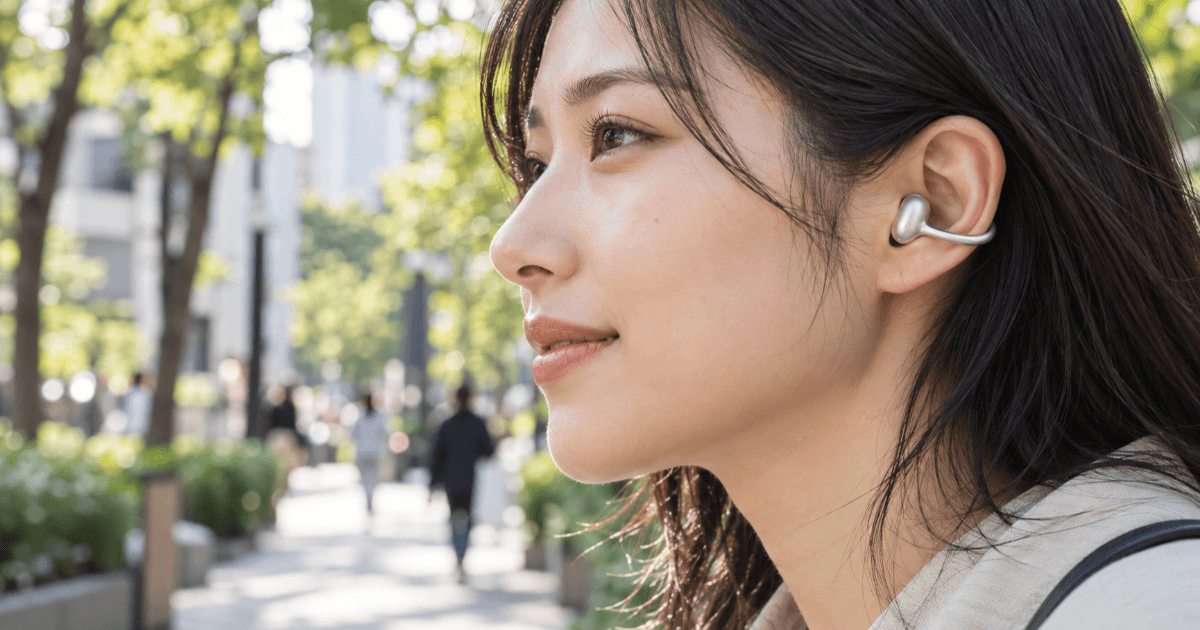
The characteristic of OWS lies in its method of delivering sound without occluding the ear canal. The term "open-ear" here refers to the wearing structure, not necessarily meaning all use bone conduction technology.
For example, Bose's Ultra Open Earbuds are worn on the outside of the ear, delivering sound from speakers directed towards the inner ear. The manufacturer highlights the ability to enjoy music while hearing surrounding sounds and a design that minimizes sound leakage.
The reasons for this usage are easy to imagine. Listening to a podcast while folding laundry at home. Noticing when someone calls you while working at a desk. Enjoying music and the sounds of the city together while walking. In such scenarios, being connected to the surroundings through sound itself becomes a convenience.
However, just because the structure does not occlude the ears does not mean it is comfortable for everyone. Compatibility with ear shape, wearing position, and clamping force remains. It is appropriate to view it as a strong option for those who dislike the pressure of traditional earphones.
Earring-Like Shapes Change Selection Criteria
According to Omdia, clip-type accounted for 61% of OWS shipments, while ear-hook type accounted for 39%. The clip-type is supported not only as audio equipment but also by interest as a fashion accessory.
Earphones are worn close to the face for long periods. Whether they match work attire, blend with hairstyles, or how they appear in online meetings are significant considerations alongside sound quality and battery life.
For Japanese readers, whether they interfere with glasses, masks, or earrings might also be a concern. However, this is not a result of measuring purchasing motives in Japan, but rather points to consider from everyday wearing scenarios.
Even if you like the appearance, if they shift with slight head movements or cause ear pain after a while, they are difficult to use for extended periods. Because they are small devices, compatibility that cannot be discerned from a catalog exists.
Genuine Opinions on Social Media: "I Want to Use Them All the Time, But What About Sound Leakage?"
Posts on social media and forums reveal selection criteria not visible in market statistics.
The following is a summary of consultations and user experiences about open-ear type earphones posted on Reddit, not direct responses to the Cyprus Mail article. These are personal experiences and not representative surveys of all users.
In one purchase consultation, a user was looking for a product they could wear all day at work, use for calls, music, and podcasts, and still notice when someone needed help. The discomfort of in-ear earphones and the bulkiness and heat of large headphones were cited as reasons.
What is sought here is not just powerful sound but usability as a tool that can be worn for long periods without interrupting the workflow.
In another thread, there was a consultation about considering open-ear types due to discomfort with sealed ear tips, but concerns about sound leakage at work or during commutes.
Responses included appreciation for enjoying natural sounds and music together outdoors and the comfort of wearing them. However, there were also experiences shared where sharp running sounds on specific sections of train rides drowned out the earphone sound, even if they could be used for most of the commute.
Even if some users report barely noticing sound leakage, the same results may not occur with all products or volumes. Positive impressions and dissatisfaction coexist because evaluation criteria change depending on the usage environment.
In Japan, Will Usage Split Between "For Commuting" and "For Home Use"?
Considering usage in Japan, what is expected from earphones can change within the same day.
The preferred listening experience differs between the time when you want to hear audio clearly on a crowded train and the time when you want to play music at home while noticing calls. The ease of hearing surrounding sounds can be inconvenient in the former and convenient in the latter.
Of course, this does not uniformly determine that OWS is unsuitable for commuting in Japan. Conditions vary depending on whether walking is the main mode of movement or if one spends a long time in noisy subways. The Reddit comment about "difficulty hearing only on certain sections of the train" well illustrates this difference.
Regarding sound leakage, perceptions differ when alone at home versus in a quiet workplace or in close proximity to others on public transport. Even if manufacturers explain sound leakage measures, actual usage volume and distance from others are not the same.
Considering these differences, it is possible that more people will start using different earphones for immersive listening and for continuous use in daily life, rather than relying on one device for everything. This is not a trend confirmed by market data in Japan but a perspective derived from differences in usage.
Even with AI Advancements, Daily Usability Remains Crucial
The original article and Omdia's announcement point out that AI features are becoming a competitive axis in the earphone market. Examples include chips for AI processing and collaborative apps utilizing large language models.
However, the fact that AI features have become a topic of discussion does not mean they were the main driver of OWS growth. It is not possible to conclude from this data alone that the 12% growth was due to AI effects.
Additionally, the mentioned factors such as wearing comfort, sound quality, call quality, and active noise cancellation need to be read as competitive elements for the entire TWS market. This is not an explanation that all non-occluding products have the same sound insulation performance as sealed types.
For Japanese users, even if advanced audio features are added, it will be important whether they are easy to use in Japanese, naturally integrate with existing smartphones, and do not excessively increase operations. More than the number of features, whether daily hassle is reduced will influence continued use.
Before Replacing, Consider "What Do You Not Want to Miss Hearing?"
The numbers this time indicate not the disappearance of earphone demand but a change where non-occluding usage is gaining presence in a mature market.
Therefore, when choosing, it is easier to understand by considering not only "which is the most high-performance" but also "what do I not want to miss hearing?"
Do you want to focus on the details of music? Do you want to hear the voices in meetings? Do you want to notice the voices of family or colleagues while playing music? The answer to these questions changes the necessary wearing method and features.
The growth of OWS provides a clue to consider that the time to enjoy sound has spread throughout life. What is required of small devices near the ears is to deliver music and fit seamlessly into daily life. Balancing these aspects is likely to become the focus of new earphone selection.
Source URL
Cyprus Mail (October 3, 2026)
Report on the global TWS market and OWS growth, trends by shape, and competition in AI features.
https://cyprus-mail.com/2026/10/03/open-wireless-stereo-devices-buck-trend-in-falling-global-audio-marketOmdia Official Announcement / Business Wire (September 17, 2026)
Primary source on global shipment volumes for April to June 2026, regional trends, OWS share, composition of clip-type and ear-hook type, and AI features. Figures are sell-in shipments, not consumer sales.
https://www.businesswire.com/news/home/20260917343885/en/Bose Japan Official Product Page
Manufacturer's explanation of the wearing structure, how surrounding sounds are heard, and sound leakage reduction technology for the Ultra Open Earbuds. Not a document guaranteeing the performance of all OWS products.
https://www.bose.co.jp/p/open-earbuds/bose-ultra-open-earbuds/ULT-HEADPHONEOPN-BLK-WW.htmlReddit "Help deciding open ear earbud"
Purchase consultation seeking earphones to wear for long periods at work, enjoy calls and music, and still notice surroundings. Referenced to introduce social media interest.
https://www.reddit.com/r/Earbuds/comments/1s6546x/help_deciding_open_ear_earbud/Reddit "Best Semi-in-Ear or Open-Ear Earbuds?"
User posts about concerns over sound leakage at work and during commutes, comfort, outdoor use, and train noise. Referenced as personal opinions and experiences.
https://www.reddit.com/r/Earbuds/comments/1v587u6/best_semiinear_or_openear_earbuds/