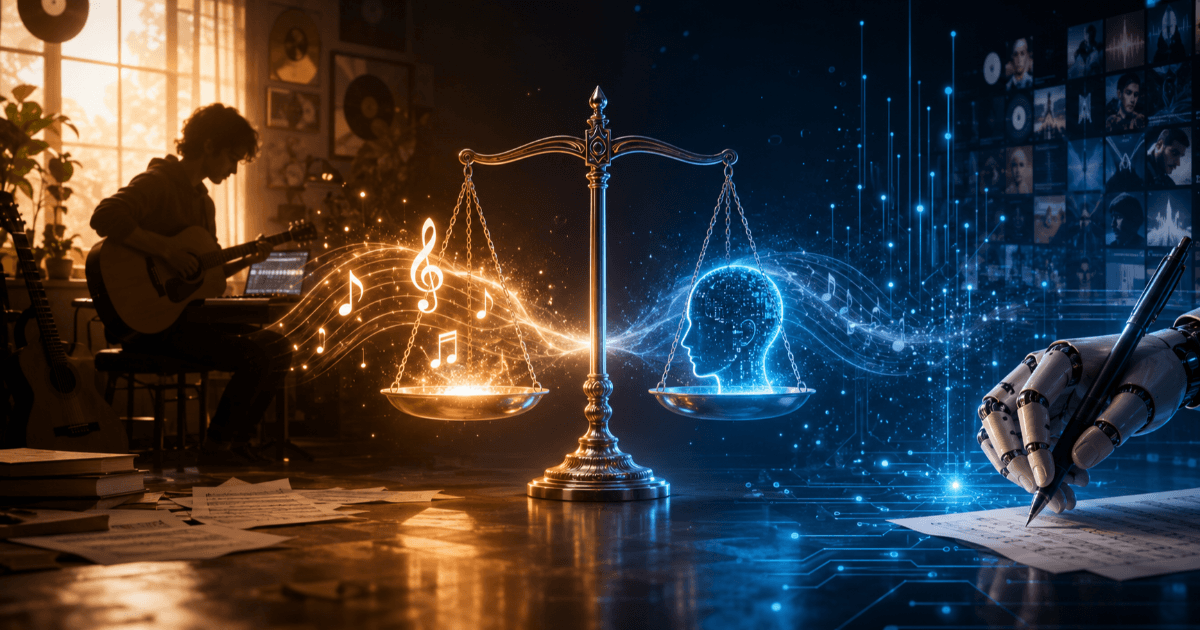
The Debate Shifts from "Using AI" to "Who Sets the Conditions"
Discussions around music-generating AI have entered a new phase.
Previously, the focus was on relatively abstract questions such as whether AI could surpass human composers, whether it would take away musicians' jobs, and whether music created by machines could be called art. However, as services capable of generating lyrics, melodies, accompaniments, and vocals from brief instructions proliferate, and as contracts between record companies, music publishers, and AI companies progress, the issues are rapidly becoming more practical.
The question now is not a simple binary choice of whether to accept or ban AI music.
Whose songs or recordings can be used for training? If a record company grants permission, is it unnecessary to confirm with the singer or the songwriter themselves? If profits are generated from the produced songs, to whom and by what criteria should they be distributed? When a voice that closely resembles the original is generated, who has the right to manage that voice? And should listeners be informed that AI was used?
An essay by John Mellor, a partner at the U.S. law firm Manatt, published in Music Business Worldwide, highlights key pillars for considering these issues: creator approval, fair compensation, voice rights, tracking of generated works, and transparency.
Underlying this is the idea that the system should not be decided solely by AI companies and rights-holder companies, but that artists and songwriters who create music should be at the center of negotiations.
The Music Industry is Exploring a Licensing Market, Not a "Total Rejection"
Major music companies are not entirely rejecting generative AI itself. Instead, they are attempting to separate services that learn from works without permission from those that process rights in advance, aiming to create a market for authorized AI music.
In May 2026, Spotify and Universal Music Group announced a new system allowing artists and songwriters who choose to participate to have their works used by fans to create covers and remixes. Both companies intend to incorporate consent, credit, and compensation into the design of the service.
Warner Music Group and Suno also announced a partnership in November 2025, indicating a policy where artists and songwriters can choose whether to allow their names, images, likenesses, voices, and songs to be used in new AI-generated works.
The partnership between Universal Music Group and Udio also emphasizes building a new AI music service using licensed music, rather than assuming unauthorized use.
These developments suggest that the music industry is not trying to exclude AI but is attempting to shift unauthorized use to a permission-based market.
However, the word "licensed" alone does not guarantee ethicality.
Even if contracts between record companies and AI companies are established, it does not necessarily mean that the individuals who actually sang, played, wrote, and composed understand the conditions. There are cases where it is unclear how the amount paid by AI companies is distributed to artists.
What matters is not the existence of a contract, but who permits what, who receives what benefits, and when they can withdraw.
The First Principle is "Substantial Consent"
The starting point for ethical AI music is the consent of artists and songwriters.
Traditional record and music publishing contracts sometimes include clauses allowing companies to broadly license songs. On the other hand, there are contracts that require the artist's approval for specific uses.
The issue here is whether the word "license" in past contracts includes generative AI learning and voice reproduction, which did not exist at the time.
Legally, the interpretation of contract terms might allow company use. However, ethically, it is undesirable to broadly interpret past contracts to force usage.
Permission to distribute a song is not the same as permission to use it for AI model training. Permission to sell existing recordings is not the same as permission to create a new voice that closely resembles the original.
Therefore, at least the following items need to be confirmed separately:
Using works as AI training data. Using existing songs for covers or remixes. Generating a voice similar to the original. Distributing generated works outside the service. Secondary use of generated audio in advertisements, videos, games. Reusing generated works for training other AI models.
The Music Artists Coalition organizes the principles necessary for AI music into three: Consent, Compensation, and Clarity.
However, a formal opt-in is not enough.
If there is pressure that refusing participation would result in disadvantages in future contracts, promotions, or playlist placements, it cannot be called free consent. Conditions such as permanent usage periods, inability to withdraw, undisclosed compensation amounts, and inability to restrict what kind of songs are generated also weaken the individual's choice.
What is needed is not just signing a consent form, but the freedom not to participate and the right to manage conditions even after participation.
The Second Principle is "Fair Compensation for Those Who Provide Value"
The compensation design for AI music is more complex than streaming.
In regular music distribution, it is somewhat possible to track how many times a song has been played. In contrast, generative AI learns features from a large number of works and creates new outputs by combining them.
Therefore, it is difficult to accurately measure which artist's work influenced a specific generated song and by what percentage.
However, just because it is difficult to calculate the influence ratio does not mean that compensation should not be paid. As long as AI models derive value from music catalogs, a method of returning that value to the creators must be designed.
Mellor argues that artists and songwriters should be treated as equal participants in the revenue generated by AI licenses. He also suggests comparing traditional contract royalties or substantial profit-sharing and adopting conditions favorable to creators.
Furthermore, it is crucial not to use past production costs or contractual unrecouped balances as reasons not to pay new AI revenues to the individual.
There are multiple stages to consider for revenue generated from AI.
First, there is compensation for providing works or recordings as training data. Next, there are usage fees when specific songs or voices are involved in generation. Additionally, there are royalties when generated works are commercially used in distribution, sales, advertising, games, or video works.
It must also be clarified whether lump sums, minimum guarantees, settlements, investments, and shares paid between companies are distributed to artists.
Without knowing "how much was received from AI companies," "what percentage was paid to the individual," and "what criteria were used to calculate the amount," fair compensation cannot be confirmed.
An Artist's "Voice" is a Right Separate from Recordings
In AI music, special care must be taken with the singer's voice.
Even if a record company manages past master recordings, it does not necessarily have the right to freely generate a new voice that closely resembles the original.
Recordings are managed by copyright and contracts, but a voice is strongly tied to the individual's personality and identity.
Fans can identify a singer just by hearing their voice. If an AI-generated voice similar to the original is used for political statements, discriminatory lyrics, adult expressions, or fraudulent advertisements, the individual's trust and reputation could be damaged, even if they were not involved.
Therefore, the use of a voice should be separated from the use of songs and managed by the artist themselves.
A system is needed that allows detailed specification of genres, lyrics, advertising categories, target regions, periods, generation counts, external distribution, secondary use, and retraining.
Contracts should not simply make a voice "available" but should allow the individual to decide "what it can be used for."
Moreover, the generation of voices by AI is not an issue only for living artists. When recreating the voice of a deceased person, ethical issues remain, such as whether permission from relatives or rights managers is sufficient and whether it aligns with the expressions the individual desired during their lifetime.
What can be technically reproduced and what can be socially utilized are separate issues.
Closed Services Do Not Guarantee "No Leakage"
Some AI music services have mechanisms that allow generated works to be played only within the service, preventing them from being taken out as audio files.
Such closed environments are called "walled gardens."
By limiting generated works to within the service, the operating company can track playback counts, distribute revenue to rights holders, and easily delete inappropriate generated works. It also reduces the risk of unauthorized uploads to video sites or music distribution services.
However, it is difficult to completely contain content.
There are many ways to take audio out, such as screen recording, external recording, unauthorized downloading, system vulnerabilities, and internal leaks. Once outside, it could be used for training other AI models or distributed with the source hidden.
What is needed is not an explanation of "absolute non-leakage," but a system that can detect, track, delete, and monetize in case of leakage.
A combination of audio fingerprinting, digital watermarking, generation history IDs, metadata including rights information, and rapid deletion windows is necessary.
The safety of AI music should be evaluated not only by the height of the service's walls but also by whether it can be tracked after crossing those walls.
Transparency is Needed Not Only Between Companies but Also for Listeners
Transparency is a prerequisite for achieving fair compensation and rights protection.
First, transparency is needed from AI companies to record companies, publishers, and artists.
It must be possible to confirm which works were used for training, which songs or voices were used how many times, whether generated works were saved, shared, distributed, or sold, and what level of revenue was generated.
Next, transparency is needed from record companies and publishers to the artists and songwriters they contract with.
They need to explain how the license fees, minimum guarantees, settlements, and investments received from AI companies were calculated and distributed to the individual.
Furthermore, transparency from platforms to listeners is also an issue.
Completely AI-generated songs, songs with human-written lyrics and AI accompaniment, songs with human-sung vocals edited by AI, authorized AI vocals, and unauthorized imitation voices cannot be distinguished by the same term "AI music."
If a display system is created, it is more realistic to indicate the processes involved rather than just the presence or absence of AI use.
If it is clear which parts used AI, such as lyric assistance, composition assistance, accompaniment generation, voice generation, sound source separation, mixing, mastering, or full song generation, listeners can choose works based on their values.
Transparency is not a mark for excluding AI works. It is information for correctly evaluating human creativity and AI assistance and distinguishing between authorized works and unauthorized imitations.
Distrust in "Management" More Prominent Than AI Itself on Social Media
On social media, opinions on AI music are fiercely divided. However, a closer look at public posts reveals that opinions are not simply split into proponents and opponents.
Note that the following is an organization of representative posts that can be confirmed on Reddit and other platforms and does not represent a survey of the opinion ratio of society as a whole.
Opinions That "Consent and Compensation Are Necessary for Learning"
From users who emphasize rights protection, there are voices that AI, which creates value by learning from existing music, should seek permission from the original artists and pay compensation.
In response to the counterargument that humans also learn from others' music, there is the opinion that listening and learning from music as a human is not the same as companies creating competing products through large-scale data processing.
Particularly problematic is the use that reproduces the original's voice or style while making it appear as if the original artist is involved. The argument is that musical influence and impersonation or commercial use of personality should be considered separately.
Opinions That "AI is a Tool to Assist Creation"
On the other hand, from users of AI music services, there are reactions that AI is not just a machine that automatically creates songs but a tool to shape human ideas.
From those who write their own lyrics and decide the emotion, structure, tempo, and musicality of a song before using AI, dissatisfaction is expressed about the entire work being dismissed just because AI was used.
There are also voices appreciating creative experiences made possible for the first time by generative AI, such as adding music to previously written poems, creating demos for those who find it difficult to gather performers, and allowing those with little musical experience to share their songs with family.
From this standpoint, AI is not something that excludes humans but is a new production technology following DAWs, synthesizers, drum machines, and auto-tune.
Debates Over AI Labeling
There is also a division of opinion over whether AI music should be labeled.
Those advocating for labeling argue that listeners have the right to choose music created by humans and that presenting AI-generated works as complete human creations is misleading. The opinion is particularly strong that clear labeling is necessary when imitating real singers or bands.
On the other hand, there is criticism from the opposing side that it is unclear from which stage a work should be called AI-generated.
Does using AI mastering alone make it AI music? What about when a human composes and AI adds only some instruments? What about when AI vocals are used with human-written lyrics?
Summarizing everything under a single "AI-generated" label could lead to misunderstandings that works with significant human involvement are fully automatically generated.
This debate indicates that if AI labeling is introduced, a step-by-step display indicating the processes used is necessary rather than a simple binary choice.
Voices Tired of the Conflict Between Proponents and Opponents
On social media, there are also voices concerned more about the aggressiveness of the debate than the content of AI music.
Posts from composers who lost professional relationships just