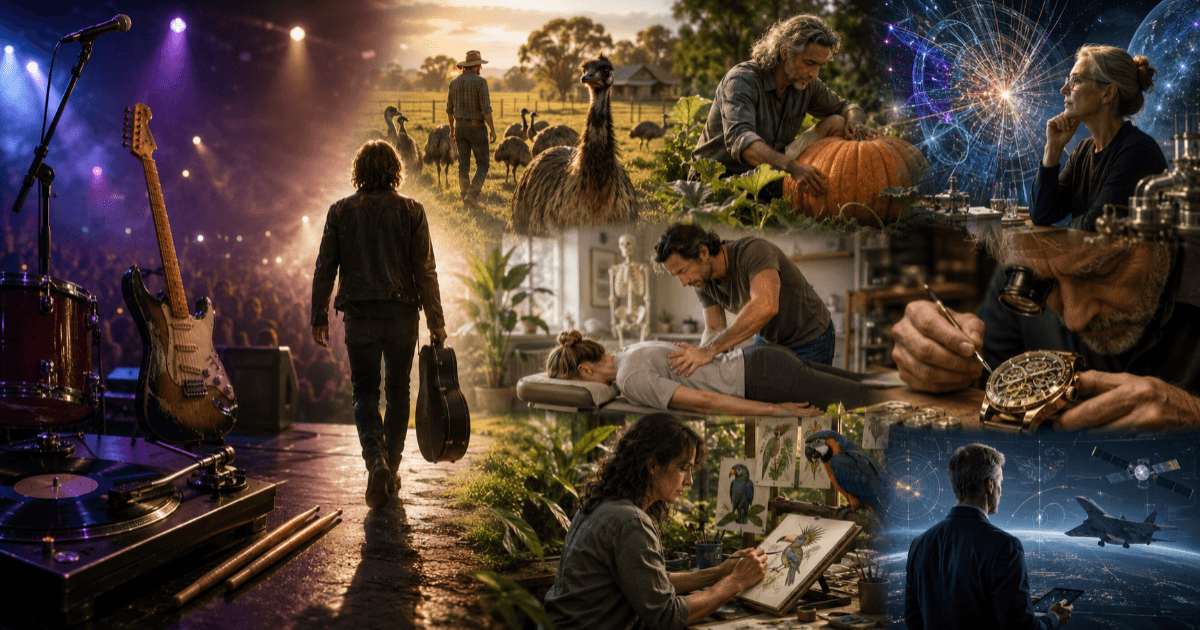
■ When Stepping Off the Stage, What Does a Person Become?
A large audience, dazzling lights, and songs climbing the charts. From the outside, a musician's success seems like an endless story. However, bands break up, relationships between members change, and stamina and interests shift over the years. No matter how famous someone becomes, there comes a time to consider "what's next after music."
Interestingly, not all musicians who leave the front lines cling to past glories. Some have moved into worlds seemingly distant from music, such as agriculture, science, medicine, crafts, nature research, and even national security.
However, a closer look at their career changes reveals that they are not complete departures. The sense of assembling sounds, the concentration to discern details, the patience honed through touring, and the attitude of not conforming to established norms—skills acquired through music continue to live on in new forms in their subsequent careers.
■ From Revolutionary DJ to Emu Farmer—Terminator X
When discussing the sound of Public Enemy, DJ Terminator X is indispensable alongside Chuck D and Flavor Flav. He supported the group's sound image by skillfully using scratching and turntables, where intense beats and political messages clashed.
However, after leaving the group and distancing himself from the music industry, he chose a life raising emus, large birds native to Australia. He returned to his real name, Norman Rogers, and engaged in farming in North Carolina, USA.
The combination of a DJ who left a mark in hip-hop history and an emu farm is so unexpected that it is still discussed with surprise on the internet. Although the farm was affected by hurricane damage and the emu farming did not last long, he has since returned to DJ activities at his own pace.
What is important here is that his return is not a simple "comeback from failure." Instead of returning to the center of the industry, he engages with music on his own terms. Having experienced a different life, he may have been able to reconsider music not as a profession or obligation, but as a choice.
■ From Guitar to Growing Giant Pumpkins—Jim Martin
Jim Martin, the guitarist who supported Faith No More during its golden era, turned to competitive growing of giant pumpkins after leaving the band.
Initially, it was just ordinary gardening on a vacant lot near his home. However, he found excitement in growing larger and heavier pumpkins and began researching factors such as seed selection, soil management, moisture, temperature, and growth rate. In 2005, he grew a pumpkin weighing nearly 500 kilograms (about 1087 pounds), drawing attention at competitions.
At first glance, heavy guitar and farming seem to have no connection. However, the world of giant pumpkin growing is not one where you can win by chance. It requires planning over months, observing minute changes, investigating causes of failure, and making improvements the following year. This approach is surprisingly similar to the dedication needed to perfect equipment and performance for good sound.
On music fan forums, while there are voices amused by his career change, there are also words that have long been passed down, such as "not everyone can grow giant pumpkins even if they can become a rock star." It reflects not just humor but also respect for someone who chose a passion over fame.
■ From Pop Band Keyboardist to Physicist Speaking About the Universe—Brian Cox
One of the most remarkable examples of career change is British physicist Brian Cox. He is widely known today as a scientist who communicates the world of space and particle physics to the public, but in his youth, he played keyboards for bands like Dare and D.
While engaged in music, he studied physics at the University of Manchester and advanced into particle physics. He earned a PhD and conducted research related to CERN's Large Hadron Collider, while also delivering science to society through TV programs, lectures, and writings. He is currently a professor of particle physics at the University of Manchester and a leading figure in science communication.
On social media, posts from people discovering for the first time that he was a former pop musician repeatedly become topics of conversation. It is not immediately obvious that "the professor explaining the universe on TV" and "the young man playing keyboards on stage in the 1990s" are the same person.
On the other hand, there are many rebuttals to viewing him as merely a "scientist on TV." Voices highlight his research history and university position, evaluating his expertise as a scientist. As his glamorous career garners attention, some people want to confirm that his current work is not just based on sensationalism.
Cox's journey demonstrates that the path chosen in youth does not determine one's entire life. Instead of completely abandoning either music or science, he pursued each at different times and later applied his stage experience to how he communicates science.
■ From Punk Drummer to Supporting the Body—Terry Chimes
Terry Chimes, the early drummer for The Clash, also played with Johnny Thunders, Billy Idol, and Black Sabbath. While he spent a long time in the intense music scene, he also strongly felt the physical toll.
Drummers use their entire bodies. Shoulders, hips, neck, and wrists are subjected to repetitive motion stress, and rest is often insufficient during tours. Chimes deepened his interest in body structure and care due to his own discomfort, eventually leaving music to study chiropractic. In 1994, he opened a clinic in Essex, UK, and also trained in acupuncture.
The contrast is significant: a drummer from a punk band with a strong anti-establishment image becomes a practitioner who works one-on-one with patients. However, both drumming and capturing subtle bodily reactions require sensitivity, repetition, and concentration.
Additionally, he is said to have deepened his faith later and engaged in church-related activities. It is not surprising if his youthful image does not align with his current values. People change, and choices that may seem contradictory to the past can be a natural growth for the individual.
■ From High-Speed Guitar to Micro Machines—Dan Spitz
Dan Spitz, who helped define an era of thrash metal as the guitarist for Anthrax, chose the world of luxury mechanical watches after music.
In watchmaking, tiny components that are difficult to see are processed, and gears and escapements are precisely assembled. Minute discrepancies can affect performance, and repairs require knowledge of the structure and extreme precision in craftsmanship. Spitz received specialized education in Switzerland and gained experience as a watchmaker handling complex mechanisms. He is currently working as an independent watchmaker, creating mechanical watches under his own name.
This career change is well-suited to social media. Since Anthrax's songs and albums contain themes that evoke "time," posts often include jokes related to clocks and time. At the same time, there is much praise for "finding something you love and mastering it to a professional level" and "the dexterity honed through playing is being put to use."
However, luxury watches are expensive, and there are enthusiasts who want to view the manufacturing background, "made in" labels, and brand strength objectively. They prefer to evaluate the watches themselves rather than relying solely on the title of a former famous musician. The attitude of judging by the standards of the specialized field, rather than just surprise and support, is also healthy.
■ Painting Birds in the Rainforest—Robert Dean
Robert Dean, who played guitar for the British band Japan, moved to Costa Rica after leaving music. There, he became deeply engrossed in tropical birds.
He observes birds, noting their characteristics, and differentiates between feather colors, postures, and differences based on gender and growth stages. He is not just painting nature as a subject but has built a reputation as an ornithologist and natural artist involved in creating field guides. He has contributed numerous illustrations to bird guides in Central America, including Costa Rica.
A musician's creativity does not reside solely in sound. The sensibility that once reached audiences on stage is now directed towards drawings that require scientific accuracy. Bird illustrations are not free impressionist paintings; they must accurately convey information useful for identification. It is a job that requires both artistic and observational scientific skills.
In later years, Dean has also returned to music in a limited capacity. This is not so much a "return to his former self" as it is placing music within the new life he has built with nature. A second life does not erase the first; it is about re-editing both into a form that allows for both.
■ Connecting Guitar and Missile Defense—Jeff "Skunk" Baxter
Jeff "Skunk" Baxter, who thrived with Steely Dan and The Doobie Brothers, has one of the most unusual careers among those discussed. He expanded his interest into military technology and security, becoming an advisor to government agencies and research organizations on missile defense, counter-terrorism, cyber warfare, and war games.
The catalyst was said to be a conversation with a former engineer living nearby. He found common ground between digital equipment used in studios and military systems in data processing and signal technology, and deepened his research independently. Eventually, he compiled a paper on applying naval systems to defense, which caught the attention of policymakers.
He is currently introduced as a senior fellow and director at a U.S. security think tank, advising on multiple fields. However, care must be taken in expressing his titles. It is closer to reality to view him as an advisor who connects knowledge from different fields and provides ideas and strategies, rather than just describing him as an engineer designing weapons.
Reactions on social media are divided. One is pure surprise and admiration, "Is there really someone with such a career?" The other questions how much of a specialized role a self-taught individual can play in the advanced field of security. While some are convinced by the commonality of signal processing between acoustics and defense technology, there are also cautious opinions that his achievements should not be exaggerated.
The very fact that these two reactions arise is evidence that his career change significantly challenges conventional career views.
■ It's Not Just the "Contrast" That Social Media Reacts To
The first reason these stories spread easily on social media is the contrast between past and present. Just one sentence like "A political hip-hop DJ becomes an emu farmer," "A metal guitarist becomes a watchmaker," or "A rock guitarist becomes a missile defense advisor" makes you want to know more.
However, following the reactions reveals that they are not merely being consumed as rare incidents.
What many people appreciate is not the magnitude of fame but the courage to become a beginner in a different field. Even former stars must learn from the basics in a new world. They earn degrees, attend vocational schools, experiment in fields, and build small skills over years. In their journey, some people find hope in "being able to restart life" and "being able to change what you love."
On the other hand, social media also has the power to verify. It checks whether the celebrity's title is exaggerated, whether they truly have professional qualifications and achievements, and whether they are still continuing that work. The more surprising the story, the more necessary it is to separate fact from embellishment. The coexistence of praise and skepticism makes the stories of second careers more three-dimensional.
■ Not Career Change, But "Translation" of Skills
When lining up the paths of the six individuals, commonalities become apparent. They did not completely abandon their past. They translated the skills cultivated in music into a different context.
A DJ's observational skills and timing translated into farm management, a guitarist's curiosity into cultivation and watchmaking, the ability to convey complex content on stage into science communication, the experience of physical exertion into an interest in therapy, artistic sensibility into bird illustrations, and understanding of sound technology into ideas for signal processing and security.
When considering a career change, many people worry that "current experience won't be useful in the next industry." However, even if the job title changes, the underlying skills are transferable. Concentration, observation, explanatory skills, manual precision, planning, and the ability to achieve results as a team. By redefining oneself in terms of abilities rather than job history, connections with seemingly distant fields can sometimes be found.
■ Life Continues Even After the Applause Stops
A musician's second act is not necessarily smaller than the first. In terms of recognition or income, it may not match previous activities. However, if the individual is deeply immersed in a new interest and can use their time at their discretion, it can be called a success.
Terminator X returned to music on his own terms after experiencing farming. Brian Cox moved from the pop music stage to the world of particle physics, now conveying the allure of science to the public. Dan Spitz shifted his passion from high-speed guitar playing to quietly ticking machines. Robert Dean observed tropical rainforest birds, recording the world's beauty in a way other than sound.
What they teach us is that "what you learn next" drives life more than "who you were."
Stepping off the stage is not the end of the story. It is after the lights go out that a second act, chosen by oneself rather than a role given by others, may begin.
・Global News "Life after music: What some artists have done for second acts"
Introducing the career changes, backgrounds, and second activities of six musicians.
https://globalnews.ca/news/11967241/life-after-music-what-some-artists-have-done-for-second-acts/
・American Physical Society "Brian Cox"
Confirming Brian Cox's career progression from music to physics.
https://www.aps.org/careers/profiles/brian-cox
・University of Manchester "Academic and research staff"
Confirming Brian Cox's current position at the university.
https://www.physics.manchester.ac.uk/about/people/academic-and-research-staff/
・Terry Chimes Chiropractic "About"
Confirming Terry Chimes' music history, chiropractic and acupuncture education, and qualifications.
https://chimeschiropractic.com/about/
・Daniel Spitz Official Site
Confirming Dan Spitz's activities as a watchmaker, independent watchmaking, and career.
https://danspitz.com/
・Bloomsbury "Robert Dean"
Confirming Robert Dean's transition from a former member of Japan to an ornithologist and natural artist.
https://www.bloomsbury.com/UK/author/robert-dean/##