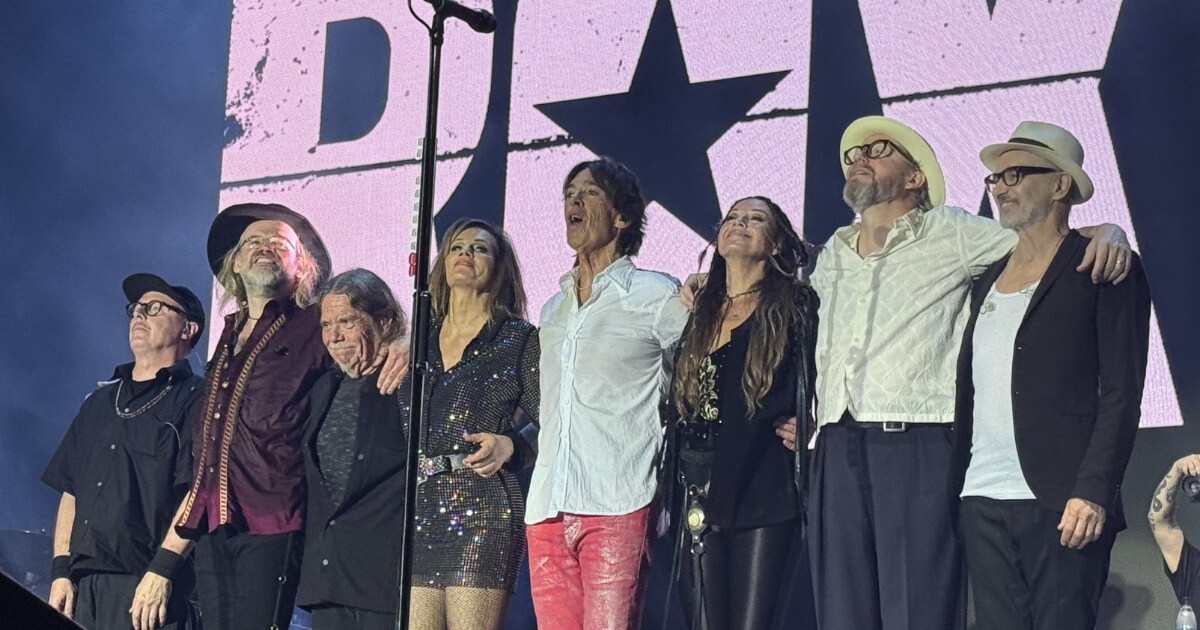
The Day the "Dream North American Tour" Disappeared—The "Too High Cost of Live" That Hit Roxette's 40th Anniversary Tour
The stage of reunion awaited by fans worldwide vanished before it could even begin.
Sweden's iconic pop rock group, Roxette, announced the postponement of their North American leg of the 40th-anniversary tour initially scheduled for fall 2026. The affected concerts were those planned in the United States and Canada.
The reasons cited in the announcement were logistical issues and the sharply increased tour costs. Although officially termed as a "postponement" rather than a "cancellation," purchased tickets will be automatically refunded. No new dates have been provided, and the North American tour initially planned for fall 2026 will not take place.
For fans, this is not just about losing a concert. It is the loss of an opportunity to confirm the 40-year journey of Roxette and a history that will never return in the same form.
The Disappearance of U.S. and Canadian Concerts
The North American tour was scheduled to take place from September 10 to October 9, 2026.
It was planned to revolve around outdoor theaters across the U.S., including performances in Canada. Although there are slight differences in reports, it was said to be a plan of 14 concerts, with 12 in the U.S. and 2 in Canada.
The concerts were set to feature Roxette's key member Per Gessle and current vocalist Lena Philipsson. Additionally, some venues were to include guest appearances by artists like Taylor Dayne and Nick Lowe.
For North American fans, this tour held significant meaning.
In some regions, it would have been Roxette's first performance in decades, and in Michigan, it was announced as the first concert in about 34 years. It was a precious opportunity not only for the generation that spent their youth in the 1990s but also for younger generations who discovered their music through streaming services and video sites to hear their iconic songs live.
Therefore, the announcement of the postponement was met with great disappointment.
Reasons: "Logistics" and "Significantly Increased Tour Costs"
According to the official announcement, the decision to postpone the North American concerts was made by the local promoter, Live Nation US.
The reasons cited were logistical issues and a significant increase in tour costs.
Overseas tours require substantial expenses that are not visible to the audience. It's not just the travel costs for the artists and band members. Instruments, sound equipment, lighting, video equipment, and stage sets must be transported from city to city, and staff is needed for setup and teardown at each venue.
For large tours, costs can skyrocket, including tour buses, trucks, air freight, hotels, insurance, security, local staff, electricity, and venue fees.
Increasing the number of concerts does not necessarily increase profits. If the travel distances are long and the intervals between venues are wide, vehicle costs, labor costs, and accommodation expenses accumulate even on days without audiences. Cross-border tours also involve additional burdens such as customs and work procedures.
Even if tickets are sold to some extent, if the final profitability cannot be expected, the promoter may reconsider the concert plan.
This time, specific financial details and ticket sales numbers have not been disclosed. Therefore, it is unclear which cost items increased and how severe they were. It is also not confirmed whether factors other than costs influenced the decision.
However, the fact that even Roxette, with their globally hit songs, could not avoid the economic risks of a North American tour symbolizes the harshness faced by the current live industry.
Per Gessle: "Of course, we are disappointed"
Per Gessle expressed his disappointment over the decision, along with Lena Philipsson and the band members.
He particularly emphasized the importance of the U.S. market.
According to Gessle, the U.S. is Roxette's largest streaming market. While their songs continue to be widely listened to, the frustration of not being able to perform in front of those fans is significant.
Regarding the decision, Gessle acknowledged that it was made by the promoter based on their calculations. The band has not lost interest in performing in North America and expressed hope to perform in the U.S. and Canada again in the future.
However, alternative dates have not been announced at this stage.
The word "postponement" leaves the possibility of resumption someday. However, without new dates or venues, it is practically akin to a retraction for fans.
Will the opportunity come again if they keep waiting? Or will the plan itself not return? The desire to hold onto hope and realistic concerns are intertwined.
Tickets are refunded, but travel expenses are not
Ticket purchasers are set to receive automatic refunds.
However, this does not resolve everyone's losses.
Some fans who planned to travel from afar had already booked flights, hotels, and rental cars. Particularly for those who purchased non-refundable discount airline tickets, the costs may not be recoverable even if the concert is canceled.
It has been reported that some fans from overseas had planned to attend the North American concerts.
On social media and fan communities, there were comments like "Even if the ticket is refunded, no one will compensate for the flight costs" and "The entire trip was planned around this concert."
Buying a ticket is not enough to see a concert.
One must apply for leave from work, coordinate schedules with family and friends, secure transportation, and book accommodations. Some arrange childcare, while others prepare for long-distance travel while maintaining their health.
The postponement of a concert is not just about losing a few hours of an event. It is about the time, costs, and expectations built up towards it suddenly losing their place.
Sadness and anger collide on social media
When the postponement of the North American tour was announced, many fans reacted on social media.
The most prominent reaction was pure sadness.
Fans who have listened to Roxette for years shared posts about how this was supposed to be their first opportunity to see them live or how they were looking forward to the concert after decades.
Especially after the original vocalist Marie Fredriksson passed away in 2019, many felt that the opportunity to hear Roxette's songs on stage again was special.
Reactions like "I've been waiting for this day for months," "I planned to go with my family," and "Will we never see them in North America again?" convey a sense of loss that cannot be dismissed as a mere schedule change.
On the other hand, there was criticism regarding the timing of the announcement.
Although there was a certain period left before the tour started, fans traveling from afar book travel and accommodations early. From the perspective of those holding non-refundable airline tickets, an earlier decision by the promoter might have avoided losses.
Therefore, there were reactions questioning, "Why couldn't they confirm profitability before sales?" "Did the cost increase happen suddenly?" and "It's unfair that only ticket buyers bear the risk."
However, the criticism is not solely directed at the band.
Since Gessle explained that the decision was made by Live Nation US, some fans are questioning the promoter's planning and ticket sales strategy. Meanwhile, there were also voices showing understanding of the circumstances that make it impossible to force a tour that doesn't break even amid rising costs for fuel, labor, transportation, and insurance.
Reactions on social media are largely divided into three categories.
The sadness of losing the concert, anger over the announcement and compensation, and concerns about the future of the live industry.
Debate on "Can Lena be called Roxette?"
The current Roxette is centered around Per Gessle and Lena Philipsson for their stage activities.
Marie Fredriksson, who was the iconic voice of Roxette, passed away in 2019 after a long battle with illness. Afterward, the band's activities were halted for a long time, but Gessle welcomed Philipsson, one of Sweden's leading singers, to continue Roxette's music live into the future.
Opinions among fans have been divided regarding this new formation.
Marie's voice and presence are irreplaceable, and some feel resistance to accepting performances with another singer as Roxette. On the other hand, there are many who support the attempt to carry on the music in a new form, rather than "replacing" Marie.
Judging by the reactions of fans who were looking forward to the North American tour, interest in the new formation was sufficiently high.
It's impossible to completely recreate the past. Nevertheless, the demand to experience songs like "The Look," "Listen to Your Heart," "Joyride," "Dangerous," and "It Must Have Been Love" with Gessle, the creator, and the band's performance remains.
What was lost this time was not just the opportunity to hear nostalgic songs.
It was also a stage to confirm how the current members would carry on what Marie left behind into the future.
Ironic News Arrives Right After a Song Hits 1 Billion Plays
The timing of the postponement announcement was extremely ironic for Roxette.
It was right after "It Must Have Been Love," a global hit also used in the movie "Pretty Woman," reached the milestone of 1 billion plays on YouTube.
The song was released in the late 1980s and achieved worldwide success following its use in the 1990 film. The fact that it continues to be listened to and discovered by new generations decades after its release is demonstrated by the 1 billion play count.
This milestone should have been the perfect tailwind to boost the 40th-anniversary tour.
Longtime fans and listeners who recently discovered Roxette through the internet would share the iconic songs in the same venue. It was an opportunity to prove on stage that the legacy of the past is connected to current popularity.
However, even if the song's digital popularity reached a record level, it did not guarantee the feasibility of the actual tour.
Being widely listened to in the streaming market and gathering thousands to tens of thousands of audiences at venues in various cities to cover transportation and labor costs are separate issues.
Even if the play count indicates global popularity, it is difficult to predict how much that popularity will translate into ticket sales in specific cities. For artists with a wide range of listeners, those who frequently listen via streaming do not necessarily purchase expensive concert tickets.
Roxette's case highlights the reality that digital success and the profitability of live business do not always align.
Not Just Roxette: A Wave of Tour Cancellations
In 2026, several renowned artists have announced cancellations, postponements, or scale reductions of tours and performances.
Reasons vary, including health issues, family matters, production schedules, and personal rest. Cases similar to Roxette's, where logistics and profitability are believed to be factors, have also been reported.
The live market saw a significant recovery after the COVID-19 pandemic. However, ticket prices borne by audiences have also risen, along with travel and accommodation costs.
Artists want to pass on the increased costs to ticket prices. However, if prices are raised too much, seats may remain unsold. If prices are kept low, the overall profit of the tour shrinks, making it difficult to withstand unexpected cost increases.
Furthermore, if many popular artists tour at the same time, they compete for the entertainment budget of the audience.
Fans do not have just one favorite music. They must choose from multiple performances, considering the high ticket prices and travel costs. People who used to attend two or three concerts may now focus on just one.
In such an environment, even artists with global recognition cannot guarantee the success of a large-scale tour based solely on past achievements.
European Concerts Continue as Planned
While the North American concerts are postponed, the European tour continues.
In addition to concerts in Germany, dates are also scheduled in Switzerland, and at least concerts outside North America have not been entirely canceled.
This aligns with the explanation that the direct cause was not the health of the members or internal band issues, but rather logistics, costs, and financial planning specific to the North American tour.
North America has a vast land area, and the travel distances between venues are long. Depending on the arrangement of concert cities, the transportation burden can be greater than that of a European tour.
While the continuation of the European concerts is a relief for fans, it is complex for North American fans.
Few people can cross the ocean to attend European concerts. Moreover, those who have already incurred losses from airline tickets may find it difficult to plan a new trip.
Is There a Reunion Beyond the "Postponement"?
As of now, new dates for the North American tour have not been set.
If the promoter recalculates profitability and reviews the venue size, number of cities, travel routes, and stage equipment, there is a possibility that the concerts could be realized in a different form.
For example, reducing the number of concerts to focus on major cities, choosing smaller venues than outdoor theaters, simplifying stage equipment, or holding multiple concerts in the same area to reduce travel costs are possible methods.
However, these are merely general options