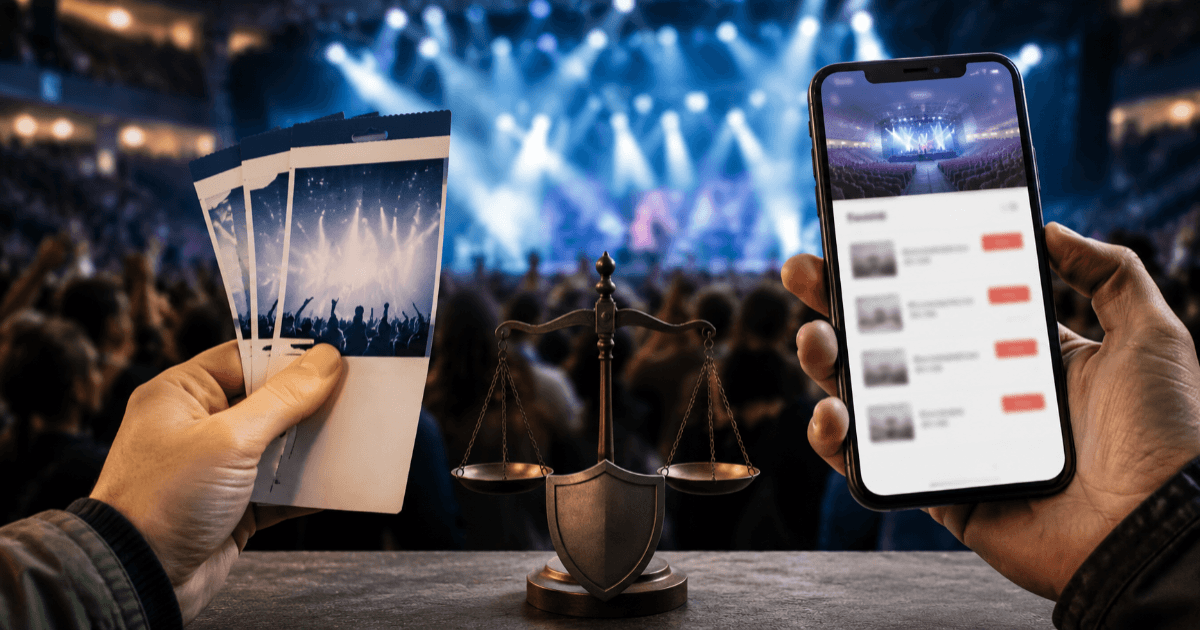
Tickets for a popular artist's performance go on sale. Gripping a smartphone, you refresh the screen repeatedly at the start of sales. Just when you think you've connected to the purchase page, it displays "Sold Out."
However, just a few minutes later, tickets for the same performance appear on secondary market sites. The prices are twice, three times, or sometimes nearly ten times the face value. Tickets are listed without detailed seat information, or even those that the seller might not have obtained yet.
Such scenes are not uncommon for music fans in Japan. Currently, Germany is making significant moves to address this issue.
Stefanie Hubig, Germany's Federal Minister of Justice and Consumer Protection, has announced plans to present a bill to regulate the secondary ticket market after the summer recess of the parliament. The consideration is for a legal price cap linked to the original sale price.
It's not about completely banning resale itself. There will still be a way for those who can't attend an event due to illness, work, or family reasons to transfer their tickets to others. While allowing for a certain administrative fee, the idea is to curb significant markups for profit.
The debate in Germany is evolving into a larger question of whether tickets should be left to the market as ordinary goods or protected as special rights to participate in culture and sports.
Even when sold at several times the face value, the side supporting culture doesn't benefit
The original article highlighted the situation where tickets are resold for multiples of their original price and the sense of crisis among event organizers regarding this.
The article also introduces an example from a Rammstein concert held in Leipzig, where named tickets linked to purchaser information were adopted to prevent resale for profit.
Named tickets have a certain effectiveness as a measure against resale. By matching the information of the purchaser and the attendee, it becomes difficult for third parties to buy in bulk and sell anonymously at high prices.
However, making tickets named does not solve everything.
How to handle name changes if one can't attend the event? Can tickets be transferred to family or friends? To what extent will identity verification be conducted at the entrance? Will it take too long and cause long lines? Will it exclude those without smartphones or visitors from overseas?
The stricter the measures to prevent resale, the more burden it places on legitimate purchasers, creating a contradiction.
Nevertheless, organizers and artists are calling for regulation because the profits generated by high-price resales are rarely returned to those who create culture.
Even if a fan pays 200 euros for a ticket priced at 60 euros, the 140-euro difference does not go towards the artist's production costs, venue staff wages, or the operating costs of the next performance. Much of it becomes the profit of resellers, intermediaries, and fees for secondary market platforms.
The burden on the audience increases, but the return to artists and organizers does not. Moreover, fans who spend a lot on tickets might refrain from buying food, drinks, or merchandise at the venue, or attending other performances.
High-price resale may seem like a personal transaction over a single ticket, but in the long term, it has a structure that takes away consumption from the entire live industry.
The "25% Cap" Sought by the German Music Industry
In May 2026, German artists, event organizers, and music-related organizations submitted an open letter titled "Against High-Price Sales and Fraud" to the government.
Participants included prominent German artists such as Die Toten Hosen, Die Ärzte, Nina Chuba, Kraftklub, and AnnenMayKantereit.
The measures sought by the industry are mainly as follows:
First, limit the resale price for profit to a 25% increase over the original price.
Second, prohibit mass purchases using automated purchase programs, known as bots.
Third, prohibit "short selling," where tickets not actually owned are listed first.
Fourth, clearly display the original sale price, seat, and whether the seller is a business or an individual.
Fifth, create a system where unauthorized listings by organizers are notified to the platform and promptly removed.
The secondary market is a mix of pure personal transfers and profit-driven resales. Selling a ticket at face value by someone who became ill and can't attend is socially different from buying dozens of tickets from the start with the intent to profit.
The goal of the German government and industry is to institutionally separate these two.
Bots Can Become "Purchasers" Faster Than Humans
In current ticket sales, it's not always the case that a reseller is repeatedly pressing the purchase button alone.
With automated programs, multiple accounts can be created in a short time, and purchase procedures can be carried out in parallel. While regular fans are entering their names, addresses, and payment information, bots complete multiple purchase processes.
Even if sales sites limit the number of purchases per person, using fake email addresses, multiple payment information, or someone else's name may not be sufficient countermeasures.
And right after the general sale ends, tickets appear on secondary market sites.
This is not the result of demand coincidentally concentrating but can be seen as a business that uses technology to secure a more advantageous position than general buyers and artificially create a supply shortage.
While some view resale as part of the free market, if the original purchase competition is not fair, it raises the question of whether the prices formed there can be called pure market prices.
Not Only Expensive but Also Risky for Entry
The problem with secondary markets is not just the price.
In cases where the same electronic ticket or barcode is sold to multiple people, only the first person to enter can get into the venue. Tickets purchased with stolen credit card information may be invalidated once the fraud is discovered.
In short selling, where tickets not yet in possession are listed, buyers may not receive their tickets until just before the event. Even if they don't arrive, the opportunity to purchase replacement tickets at the regular price has already been lost.
Even if a sales site advertises "safe" and "guaranteed," it's unclear to users whether that guarantee means the validity of the ticket or just a refund if entry is denied.
For those who have paid for travel and accommodation for the event, a refund of just the ticket price does not recover the loss.
Welcoming Regulation on Social Media, but Also Doubts About Government Proposals
On German-speaking social media and forums, there are many positive reactions to price caps and bot regulations.
Comments include, "Transactions listed at many times the purchase price right after buying are not normal personal transfers," "A slight markup over the face value might be acceptable, but not hundreds of percent," and "It would be better if transfers could only be done through official resales."
On the other hand, there are also criticisms that government regulations alone will only solve part of the problem.
Particularly common are voices criticizing the fees and market dominance of major companies handling primary sales. There is strong dissatisfaction with tickets being expensive even at the official sales stage, with multiple fees added.
Regarding dynamic pricing, which changes primary sale prices according to demand, there is criticism that "even if resellers are regulated, if the official sellers themselves sharply raise prices, the burden on fans won't lighten."
There is also the opinion that "simply displaying the original price is meaningless." If the only tickets left for a must-see event are high-priced resale tickets, buyers will purchase them even if they understand the markup is unfair.
The argument is that what's needed is not just information disclosure, but a system that actually stops listings and holds violators and platforms accountable.
On social media, there are also technical proposals, such as verified accounts, purchase limits per payment method, resale within official sites, and not displaying ticket information until just before the event.
However, it should be noted that these are qualitative trends visible from public posts and do not represent overall public opinion statistics.
Japan Already Has a Law Against Illegal Resale
In Japan, the law prohibiting illegal resale of tickets was enacted in June 2019.
The law prohibits acts such as reselling "specified entertainment admission tickets" at prices exceeding the sale price without the organizer's consent, with the intent to do so repeatedly and continuously. Even individuals can be subject to punishment if they are deemed to have the intent to gain continuous profit.
Violators may face up to one year in prison or a fine of up to 1 million yen, or both.
In this regard, Japan is ahead of Germany, which is just beginning to develop its legal framework.
However, Japan's law does not uniformly prohibit all tickets and all high-priced transactions.
To be subject to the law, certain conditions must be met, such as a display prohibiting paid transfers without the organizer's consent, specifying the date, place, seat, or admission qualifiers, and measures to confirm the purchaser's or attendee's name and contact information.
Moreover, even if resale exceeds the face value, whether it is done "as a business," meaning with the intent to do so repeatedly and continuously, is crucial.
Therefore, for users, it is difficult to determine whether the listing in front of them is a legal violation or merely a breach of terms of use.
Even with the law, unofficial site or SNS transactions have not been completely eliminated.
"Make It Strict, but Also Easy to Use" Appears on Japanese Social Media
There is strong opposition to high-priced resale on Japanese social media as well.
When identity verification was conducted at popular events, there were supportive voices saying, "Tickets should be invalidated so that real fans can enter," and "The problem is that name lending and mass purchases have been left unchecked."
On the other hand, there is also dissatisfaction with the operation of identity verification and the inconvenience of electronic tickets.
If all companions need a smartphone, a dedicated app, and a domestic phone number, it becomes difficult for children, the elderly, and overseas residents to use. Even if one suddenly can't attend, the official resale acceptance period is short, the target events are limited, and there is no guarantee that listings will sell.
Posts from users trying to attend Japanese events from overseas repeatedly ask whether tickets bought from unofficial resale sites are valid and whether entry is possible even if the name is different.
Furthermore, even with official resale, if the price setting and fees are unclear, questions arise like "Why is it more expensive than the face value even though it's official?"
What Japanese fans are asking for is not to loosen identity verification. They want strict resale measures, while also making legitimate transfer methods simple and understandable.
In a private survey conducted in 2025 targeting 1,200 people with ticket purchasing experience, 73.3% said they could not tolerate resale activities. 64.9% supported preventive measures such as facial recognition and official resale.
On the other hand, among those who have experienced purchasing or considering purchasing resale tickets, 48.7% reported experiencing some trouble, such as not being able to contact the seller after payment, not receiving a refund when an event was canceled, or finding out that what they thought was face value was actually a high-priced resale.
Despite strong support for regulation, the reason people continue to use the resale market is also due to the lack of options after failing to obtain tickets through official sales.
Differences Between the German and Japanese Approaches
There are differences in the approach between the system being considered in Germany and the law in Japan.
Japan criminalizes the act of reselling tickets that meet certain conditions at prices exceeding the face value without the organizer's consent, with the intent to do so repeatedly and continuously.
On the other hand, the discussion in Germany is moving towards allowing private resale in principle while setting a cap linked to the original price.
If the cap sought by the industry is adopted, for example, a 100-euro ticket could be resold for up to about 125 euros. This design covers certain fees and transaction costs while curbing speculative profits.
The advantage of this approach is that it is relatively easy to judge from the price whether there is a violation.
In Japan, there are judgment factors that are difficult to discern from the outside, such as the intent to do so repeatedly and continuously or the requirements of the ticket. With a price cap approach, platforms can automatically determine whether the original price and cap are exceeded.
However, there is the issue of what to include in the original price. If the ticket itself, issuance fee, system usage fee, payment fee, and shipping costs are set separately, the base price becomes ambiguous.
Even if only a price cap is set, adding fictitious service fees can circumvent regulation. Unless the final total payment is used as the standard, effectiveness will be low.
Five Things Japan Can Learn from Germany's Discussion
The presence of a law in Japan should not lead to the conclusion that Germany's actions are irrelevant. Rather, there are hints for advancing the system to the next stage.
1. Hold Platforms Accountable
Current measures tend to focus on punishing the reseller themselves.
However, if platforms that list large numbers of high-priced listings and earn transaction fees continue to evade responsibility as mere providers of space, the market will not disappear.
It is necessary to clarify the obligation to check the original price, seller identity, number of listings, and past transaction counts, and to suspend listings with strong suspicions of violations.
2. Make Official Resale the Standard, Not the Exception
Official resale should not be an additional feature prepared only for some popular events but should be incorporated as a principle into all target events.
If a purchaser can no longer attend, they should be able to list the ticket with a few operations from their purchase history, and when completed, the original ticket should be automatically invalidated, and a new electronic ticket issued to the