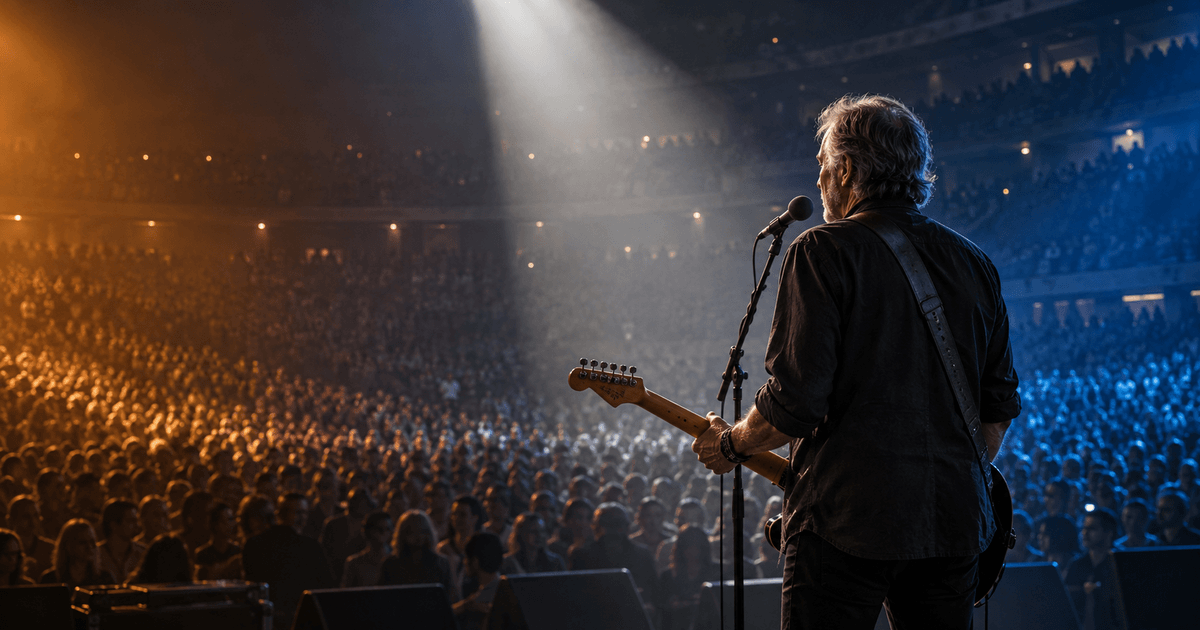
Those who have had long and successful careers have the option of remaining silent.
They can deliver only their work, keep a distance from politics, and avoid provoking fans with opposing views. In an era where reputation influences everything from advertising to box office, streaming, and social media, this seems like the most rational way to protect oneself.
However, Peter Maffay, a rock singer representing Germany, believes that staying in that "safe zone" is actually dangerous. In an interview with the German magazine 'stern,' he touched on the electoral success of the right-wing party "Alternative for Germany (AfD)" and criticized the democratic established parties for losing connection with the people, ignoring basic life needs and anxieties, and failing to speak in the language of the people.
At the same time, he did not label those who voted for the AfD with a single tag. He expressed that not everyone who chooses the AfD is "far-right" and sought to understand why that vote was cast. He asserted that artists must withstand headwinds and that speaking out is their duty, warning that "now, staying comfortable is dangerous."
This is not just a political comment from a celebrity. It is a difficult stance to take in a society where divisions are deepening, criticizing the other side while not ostracizing the people who support them.
The Reality of 38.2%
Just before his statement, a state parliamentary election was held in Mecklenburg-Vorpommern, northeastern Germany. According to provisional official results, the AfD won 38.2% of the vote, becoming the largest party and securing 32 seats. They more than doubled their vote share from 16.7% in 2021. Meanwhile, the SPD garnered 35.5%, the Left Party 6.5%, and the Green Party 5.7%. The CDU, long a central player in German politics, failed to reach the 5% threshold needed to enter the state parliament, with only 4.9%.
These numbers indicate more than just the continuation of traditional party competition. They reflect the reality that many voters feel "current politics do not see their lives" and have cast their dissatisfaction outside the established parties.
Of course, just because there is economic insecurity, it does not justify xenophobic or discriminatory claims. Understanding the circumstances of supporters is different from uncritically accepting a party's policies or actions. The key point of Maffay's statement is not to confuse the two.
If you dismiss supporters as "all the same," the door to dialogue closes. Conversely, if you emphasize only the background of dissatisfaction and obscure extreme claims, the principles of democracy are damaged. What is needed is to draw a clear line against discrimination and human rights violations while specifically examining why trust in established politics has collapsed.
Maffay's statement is not a one-time occurrence
Maffay did not suddenly become political. During his appearance at the Regensburg Castle Music Festival in the summer of 2026, he also opposed hatred, extremism, and racism, emphasizing the importance of "human dignity" as enshrined in Article 1 of the German Basic Law.
The important thing is that he is not presenting a list of policies like a politician but is speaking about the minimum foundation of society. Regardless of origin, skin color, or religion, human dignity should be protected, and he will not remain silent in the face of actions that undermine democratic rules. On the other hand, he also casts a critical eye on established parties, saying they have "lost the words of the people."
In other words, his stance does not end with merely shouting "anti-AfD." If democracy is to be protected, mainstream politics must also change, making it a dual criticism.
This stance is difficult to understand on social media, accustomed to political factionalism. From one side, it may seem too harsh on the AfD, while from the other, it may seem too understanding of its supporters. However, what democracy needs is not necessarily words that are easy to applaud. It is also about someone continuing to walk the narrow path left between different positions.
Three Reactions Intersecting on Social Media
Regarding the recent statement and the state parliamentary election behind it, there are broadly three reactions seen in public posts and comments. However, it is important to note that social media posts are not opinion polls, and the volume of voices does not match the proportion of society as a whole.
The first is a reaction that appreciates Maffay's stance. There are voices that perceive it as "courage" for a singer with a long career to speak about human rights and democracy, knowing the impact on support and sales. It is reported that his appeal on stage in the summer of 2026 was met with great applause at the venue.
The second is empathy for not categorically viewing AfD supporters as enemies. In election-related posts, discussions are prominent that emphasize the need to look at the background of voting behavior, such as prices, employment, regional disparities, immigration policies, and distrust of politicians, to avoid repeating the same results. The dissatisfaction that "established parties should acknowledge their failures before lecturing voters" is also part of this trend.
The third is a backlash against the singer's political statements themselves. Opinions such as "musicians should focus on music" and "celebrities should not use their influence for politics" are present, as well as voices perceiving Maffay's views as aligned with established media. Additionally, there are posts mocking the opposing camp and reactions attacking personalities, leading to discussions shifting from policy to personal likes and dislikes.
However, the demand that "musicians should not speak about politics" itself is a political attitude. Silence may appear neutral but can function as an endorsement of the status quo. This is why Maffay is wary of choosing comfort.
The "Not Overly Polished" Attitude in the New Album 'Nashville'
Maffay is set to release a collaborative album 'Nashville' with singer-songwriter Johannes Oerding on October 2, 2026. The album, comprising 11 songs, was recorded in a short period with local musicians and is said to incorporate elements of country and blues.
What the two emphasized during production was not to smooth everything out with digital processing but to leave the breathing, roughness, initial emotions, and sometimes small fluctuations in performance. They chose vitality over perfection by playing all sounds live.
There is a commonality between this production attitude and his political statements. The sense that if you erase friction and imperfections and polish everything to a form that no one dislikes, you lose humanity.
Maffay conducted a large-scale "farewell tour" in 2024, but he has not stopped his musical activities. Neither age nor career means silence or retirement for him. Rather, now that he has gained sufficient fame, the question is what he uses that position for.
Why "Celebrities Speaking About Politics" is Difficult in Japan
In Japan, there are musicians and actors who speak out on issues such as disaster support, war, discrimination, environment, and elections. However, political statements are often perceived as "unrelated to their main profession" or "divisive among fans," and concerns about impacts on advertising contracts and program appearances are also considered. As a result, even when speaking about social issues, expressions tend to be abstract to avoid conflict.
In the Japanese entertainment industry, which has been formed mainly around corporate sponsors and television, individual political statements are often treated as risks not only for the person but also for their agency, programs, and advertisers. Meanwhile, with the advent of streaming and social media, where creators can directly deliver their words, freedom of expression has expanded, but so have the risks of backlash and misrepresentation.
What Maffay's statement throws at Japan is not a simple command that "celebrities should also express political positions." The question is how much people with social influence can take responsibility for their words and accept criticism.
Moreover, there is responsibility on the part of the audience. When a favorite artist expresses an opinion different from one's own, do you deny their work? Do you judge the entire person based on a short excerpt? Or do you listen to why they think that way, even if you can't agree with some parts? The maturity of democracy is reflected not only in those who speak but also in the attitude of those who receive dissenting opinions.
"Raising a Voice" and "Listening" Go Hand in Hand
It is easy to simply express concern over the rise of the AfD. It is also easy to dismiss supporters as "incomprehensible" or, conversely, to overlook extreme actions due to dissatisfaction with established politics.
The difficult part is listening to the words of dissatisfied people while upholding the principles of democracy. Maffay criticized established parties for not fulfilling that role, while also stating that as an artist, he must not remain silent. The weight of his statement lies in not shifting the responsibility solely onto politicians.
Music is one of the few spaces where people from different backgrounds can gather in the same place and share the same songs. However, that sense of unity can also merely cover up social conflicts temporarily. When a figure on stage presents inconvenient questions between pleasant songs, the audience is returned from being consumers to being citizens.
The words "now, staying comfortable is dangerous" are not directed only at politicians and celebrities. The screen of social media that displays only opinions similar to one's own, the habit of categorizing opponents with a single word, and the resignation that nothing will change even if you vote. It is at the end of these small comforts that democracy weakens without a sound.
Are you prepared to both raise your voice and listen to different voices? The statement of a 77-year-old rock star poses this question not only to the distant German election but also to us in Japan.
Source URL
stern: Interview with Peter Maffay. An article reporting on his statements about the AfD's electoral success, the distance between established parties and citizens, and the responsibility of those who express themselves to speak out.
https://www.stern.de/kultur/musik/peter-maffay---jetzt-bequem-zu-sein--waere-gefaehrlich--38290002.htmlRND/dpa: A news article conveying the content of the statement in stern and the planned release of the collaborative album 'Nashville.'
https://www.rnd.de/promis/peter-maffay-ueber-afd-erfolg-jetzt-bequem-zu-sein-waere-gefaehrlich-IVEZ5BQAAVFLBC3575ZBPUVD6Y.htmlMecklenburg-Vorpommern State Parliament: Provisional official results of the 2026 state parliamentary election. Referenced to confirm the vote share, number of seats, and voter turnout for each party.
https://www.landtag-mv.de/aktuelles/artikel/landtagswahl-2026-vorlaeufiges-amtliches-endergebnisWELT/dpa: An article reporting on the recording method, musicality, and tour plans of the collaborative album 'Nashville' by Peter Maffay and Johannes Oerding.
https://www.welt.de/regionales/hamburg/article6a36fe12af14c0b52896112e/peter-maffay-und-oerding-kuendigen-gemeinsames-album-an.htmlWELT/dpa: An article reporting on Maffay's statements opposing hatred, extremism, and racism, and advocating for human dignity during his stage performance in Regensburg.
https://www.welt.de/regionales/bayern/article6a594116c722326276498d98/peter-maffay-mit-klarem-appell-gegen-radikale-positionen.htmlReddit "r/de" Election Thread: Referenced to confirm the points of public comments regarding the state parliamentary election. Social media reactions are not used to determine trends as they do not represent typical public opinion.
https://www.reddit.com/r/de/comments/1wl9f0l/landtagswahl_mecklenburgvorpommern_2026/Reddit "r/MapPorn" Election Results Post: Referenced to confirm the breadth of reactions, including those from overseas users, regarding regional results.
https://www.reddit.com/r/MapPorn/comments/1wm9hom/state_election_germany_2026_mecklenburgwestern/