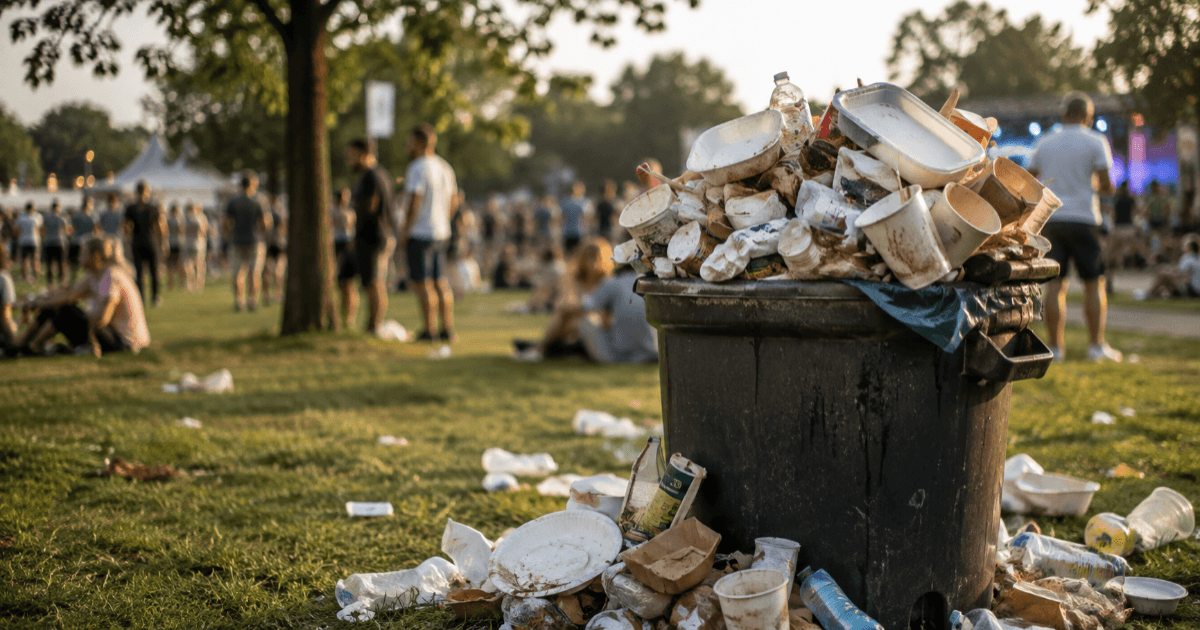
On summer evenings, people gather on the lawn, and music resonates from the stage.
In their hands are cold drinks. Laughing with friends while eating food bought from stalls, the lights illuminate the venue as the sun sets.
Summer outdoor festivals are special moments that occur only on that day and in that place.
However, after the music stops and people leave, another scene emerges.
Empty cups. Paper plates. Plastic bottles. Cans. Food containers. Napkins.
Waste overflows from trash bins and piles up around them.
This issue of summer outdoor festivals and waste was reported by Main-Echo from Frankfurt, Germany, on August 9, 2026.
People's responses vary.
Some place their trash next to full bins.
Others search for another bin.
Some take it home in a bag.
And some leave it behind and go home.
At first glance, this issue might seem to be dismissed as "audience manners."
However, when looking at the situation in Japan, a more complex picture emerges.
The personal responsibility of "you should take your trash home."
The organizer's responsibility of "if you gather tens of thousands of people, you should provide enough collection points."
And even before that, there's the issue of event design: "don't produce a large amount of disposable containers in the first place."
The trash left after a festival reflects not only the participants' morals but also how the event is designed.
In Germany, the "disposable" issue of large festivals is a concern
In 2026, the German Environmental Aid (Deutsche Umwelthilfe, DUH) investigated waste management at ten large-scale music festivals.
The festivals investigated included major German events such as Fusion, Hurricane, Lollapalooza, MS Dockville, Nature One, Parookaville, Rock am Ring, Rock im Park, Southside, and Wacken Open Air.
DUH particularly highlighted the problem of the large number of disposable products used for serving food and drinks.
According to the organization's estimates, about 600,000 disposable cups, 250,000 beverage cans, and 500,000 disposable food service items were used over three days at Parookaville.
This results in over 23 tons of "avoidable disposable waste."
Of course, these are estimates by DUH, not official waste statistics.
Nevertheless, these symbolic numbers highlight the structure where a large number of containers are consumed in just a few days of entertainment events.
On the other hand, improvements are being made.
DUH's investigation found that eight out of the ten festivals surveyed used reusable containers for cold drinks.
The problem is that even if drinks are served in reusable containers, if plates, trays, cutlery, packaging, and camping gear remain disposable, the total amount of waste cannot be sufficiently reduced.
About 300 tons at a festival of 80,000 people—the problem also centers around the campsite
The waste from large festivals is not just food and drink.
In an example introduced by German public broadcaster ZDF in 2025, about 481 tons of waste were generated for approximately 85,000 attendees at Rock am Ring in 2019.
Although it decreased to 294 tons for about 80,000 attendees in 2024, it is still hundreds of tons for a single event.
Furthermore, experts introduced in the same report estimate that about 60% of the waste is generated in the camping area.
It's not just food packaging.
Cheap tents.
Folding chairs.
Mats.
Broken camping gear.
Unused daily necessities.
"It's easier to leave it here than to take it back."
If only one participant makes that decision, only one tent is left behind.
But if a few percent of tens of thousands of participants make the same decision, a large amount of bulky waste is left the next morning.
The festival waste problem can be seen as an issue where the psychology of "it's just me" is magnified by tens of thousands of people.
So, what about Japan?
When images of large amounts of trash left overseas circulate on social media, in Japan, there are often reactions like,
"In Japan, we take it home."
"It's natural to dispose of your own trash."
"Overseas, it's dirty even with trash bins."
Such reactions appear.
The image of Japanese supporters cleaning the stands at international soccer tournaments is sometimes featured in foreign media, reinforcing the image of a "society that doesn't dirty public places" in Japan.
Indeed, calls to "please take your trash home" are not uncommon at Japanese events.
However, it's unrealistic to think that "trash problems don't occur in Japan."
In reality, after summer fireworks festivals, tourist spots, and large-scale events, large amounts of trash are often left behind, and local residents or volunteers repeatedly clean up.
Japan also faces the same problem.
The difference lies in "at what stage and to whom the disposal is requested."
In Japan, 38.11 million tons of general waste per year
According to the Ministry of the Environment's report on the status of general waste disposal for fiscal year 2024, published in March 2026, the total waste emissions in Japan were 38.11 million tons.
This is a 2.2% decrease from the previous year's 38.97 million tons.
Per person, it's 839 grams per day.
For household waste alone, it's 466 grams per person per day.
The recycling rate is 19.3%.
These figures are statistics for general waste as a whole and differ in definition from Germany's packaging waste statistics or waste amounts for individual festivals, so simple international comparisons cannot be made.
However, the fact remains that a vast social infrastructure is in motion in Japan to collect, incinerate, recycle, and finally dispose of large amounts of waste every day.
Even if trash disappears from sight at event venues, it doesn't mean it "disappeared."
Someone collects, transports, sorts, and processes it.
Japan's unique "take it home because there are no trash bins"
There is interesting data when considering the characteristics of Japan.
In a survey of foreign tourists visiting Japan, published by the Japan Tourism Agency in 2025, 21.9% cited "lack of trash bins" as a problem during their trip.
When asked about their actions when faced with a lack of trash bins, over 70% in both urban and rural areas answered that they "gave up on disposing and took it home."
This well represents one characteristic of public spaces in Japan.
"If there are no trash bins, don't throw it away there, hold onto it yourself."
For those living in Japan, this is not such an unusual action.
However, there are two perspectives on this.
One is a positive view that the habit of taking trash home leads to the cleanliness of public spaces.
The other is the view that it might just be solving the inconvenience of "no place to throw away" through individual endurance.
In daily life, you can just put an empty plastic bottle in your bag.
However, at festivals or fireworks festivals where tens of thousands gather and large amounts of food and drink are sold, the same approach may not suffice.
Fuji Rock shifts from "discarding" to "returning to resources"
Among Japanese festivals, one event that has long emphasized environmental measures is the FUJI ROCK FESTIVAL.
Fuji Rock has been working on separation and resource circulation within the venue under the concept of "waste = resource" in collaboration with NPOs and others.
The scale of this effort is evident in the 2025 results published in April 2026.
In 2025, 1,450 kilograms of paper cups collected at the venue were recycled into toilet paper for use at the venue the following year.
According to the organizers, this is equivalent to about 4,590 rolls.
Additionally, 4,950 kilograms of PET bottles separated at the venue underwent "bottle-to-bottle" horizontal recycling to create new PET bottles from used ones.
The initiative to collect surplus food and beverages from vendors and provide them to food banks resulted in 1,956.1 kilograms being donated in 2025.
The important thing is that it's not just about appealing to participants to "please don't throw away trash."
It's about what to do after it's discarded.
How to separate it.
What to recycle it into.
Who to connect surplus food to.
All of this is included in the system.
The characteristic is that the event itself is trying to incorporate resource circulation, rather than relying solely on the efforts of "environmentally conscious participants."
RISING SUN supports "13 separations" with about 160 people
RISING SUN ROCK FESTIVAL in EZO, scheduled to be held in Ishikari City, Hokkaido, on August 14 and 15, 2026, continues its distinctive environmental measures.
The official guide for 2026 states that "13 separations of waste" will be implemented at the venue.
About 160 environmental volunteers from across the country are expected to support the separation.
This initiative did not start suddenly.
Environmental volunteer activities began in 2000, and 13 separations started in 2004.
Additionally, a unique cycle is being conducted where some of the food waste is composted, and the compost is used to grow potatoes locally in Ishikari, which are then brought back to the festival venue.
For the garbage bags distributed at the venue, materials partially made from rice no longer suitable for consumption are used.
Here too, a flow is created not just to "be careful not to throw away," but to "separate," "turn into resources," and "return to the community."
At least some of Japan's large festivals are moving towards a direction that does not rely solely on "the goodwill of participants."
Yet garbage has not disappeared from Japan's summer festivals
On the other hand, looking beyond music festivals reveals a different reality.
Fireworks festivals.
In the summer in Japan, tens of thousands, or sometimes hundreds of thousands, gather on riverbanks, beaches, and parks.
They buy yakisoba or takoyaki from stalls, drink beverages, and when the fireworks end, many people head to the station at once.
Conditions are ripe for problems to occur.
In the summer of 2026, the official X account of a fireworks festival in Hokkaido called for people to take their trash home, noting an increasing trend of littering around the venue with empty cans, bento containers, and plastic bottles.
In the same summer of 2026, posts on X lamented the presence of trash in various places even days after the fireworks festival, or called for people to take their trash home, noting that the area around the venue was littered with garbage.
In other words, "Japan has a culture of taking trash home" and "littering doesn't happen at Japanese events" are not the same.
Even if the majority adhere to manners, when the number of attendees reaches tens of thousands or hundreds of thousands, a large amount of trash can be left behind by the actions of just a few.
On social media, voices say "cleaning up after yourself is natural"
On Japanese social media, whenever photos of trash after events are posted, opinions demanding participant responsibility are the first to stand out.
"You should at least take home what you brought."
"Just because the trash bin is full doesn't mean you can leave it on the ground."
"Think about the local residents who clean up the next morning."
These are the types of reactions.
This is similar to discussions on social media about festivals in Germany and overseas.
A common global sentiment is the backlash against the mindset of "once you leave the area, the trash problem is over for you."
But in reality, it isn't over.
Someone picks it up the next morning.
##HTML_TAG