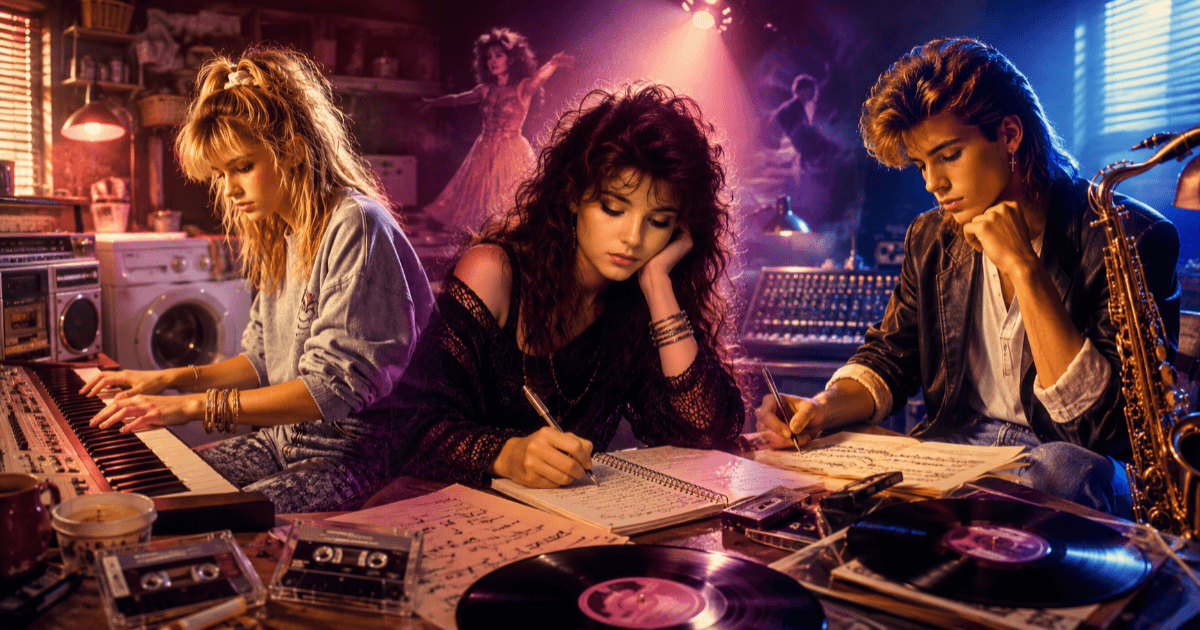
Teen Sensibilities That Shaped the '80s: Three Iconic Songs by Debbie Gibson, Kate Bush, and George Michael Born from Remarkably Young Talent
Reflecting on the pop music of the 1980s, we see flashy synthesizers, enormous hairstyles, MTV's visual culture, and stadium-level stars. Yet among the iconic songs that supported this dazzling era, some were written at surprisingly young ages.
These weren't hits meticulously crafted by adult songwriting teams. They were songs transformed from the emotions of teenagers still navigating school, first love, family, and future anxieties. It's not immaturity but rather the unrefined nature that delivers emotions directly. With little experience, they use words that go straight to the core without unnecessary embellishments. Some of the iconic songs of the '80s were born from this "strength of youth."
This time, we focus on Debbie Gibson's "Foolish Beat," Kate Bush's "The Man With the Child in His Eyes," and George Michael's "Careless Whisper." While all are songs that have been talked about for years, their starting points in creation were rooted in teenage sensibilities.
Debbie Gibson's "Foolish Beat"—A U.S. No. 1 Captured by a 17-Year-Old
Debbie Gibson's "Foolish Beat" is remembered as a bittersweet ballad of '80s teen pop. But the song's greatness isn't just in its success as a hit. She wrote, sang, and was deeply involved in the production of this song as a teenager, ultimately reaching No. 1 on the Billboard Hot 100. Her official profile introduces her as the youngest artist to write, produce, and perform a No. 1 hit on the Billboard Hot 100 with "Foolish Beat" at age 17.
Looking back now, this fact is significant. The music industry of the '80s wasn't as conducive to "making music in your bedroom and delivering it to the world" as it is today. There were no social media or streaming services, and the power of record companies, radio, TV, music magazines, and MTV was overwhelming. In such a time, for a teenage female artist to break records with a self-written song, rather than being just a "singing idol," carries weight.
As mentioned in the original article, Gibson's early songwriting was reportedly done in a studio-like space converted from her home's garage. Moreover, it was a domestic space that also doubled as a laundry area. Not in a professional, large studio, but in a place with the sounds of everyday life, a teenage girl faced her melodies. This episode well represents the charm of "Foolish Beat."
The song itself is a classic ballad singing of the regret of a broken heart. It doesn't have flashy dance beats but rather an introspective, slightly mature sadness. The title "Foolish Beat" suggests the foolish heartbeat or the rhythm of oneself being swayed by love. Teenage love can sometimes feel like the end of the world. Gibson's strength as a songwriter lies in making that emotion a pop song without excessive dramatization.
On social media and in music communities, there's a recurring sense of amazement about this song: "Did she really create all this by herself at 17?" In Reddit's '80s music community, there are posts introducing "Foolish Beat" reaching No. 1 and highlighting her record of writing, producing, and singing it at a young age. Additionally, in Gen X communities, while nostalgically remembering Debbie Gibson as a symbol of '80s mall pop, there are also reactions re-evaluating her songwriting abilities.
Interestingly, this song reaches not only the generation that experienced that time but also listeners who are retrospectively exploring '80s pop. Around the official music video on YouTube, there are not only nostalgic reactions but also perceptions like "Songs from this era have strong melodies" and "It's so well-crafted for someone so young." Debbie Gibson is being rediscovered not just as a nostalgic icon but as a "self-composed teen pop star."
Kate Bush's "The Man With the Child in His Eyes"—Fantasy and Maturity That Seem Unbelievable for a 13-Year-Old
Kate Bush's "The Man With the Child in His Eyes" is a work with a particularly large gap between its "age" and its creation among the three songs discussed. Generally, it's said that she wrote this song at the age of 13 and recorded it at 16. Included in her debut album 'The Kick Inside' and released as a single, this song also achieved success on the UK charts.
When people hear that a 13-year-old wrote a song, they might imagine something more direct and simple. However, "The Man With the Child in His Eyes" is different. With a delicate composition centered around the piano, a melody that feels dreamlike, and a perspective that looks at the boyishness remaining in an adult man, it's closer to a psychological vignette than a mere love song.
Kate Bush's music later developed into a unique world involving literature, theater, physical expression, and visual beauty. The seeds of that can already be seen in this early song. It's not unfinished because she's young; rather, because she's young, she can naturally traverse the boundary between reality and fantasy. The feelings that might be logically sorted out in adulthood are left as they are and turned into music.
On social media and fan communities, there's often talk about the disbelief that "she created these lyrics and atmosphere at 13." In Reddit's Kate Bush-related community, there are discussions about the background and interpretation of the song, with posts accepting it as a song based on her own young emotions and longings. Meanwhile, there are also reactions to the song's age gap and fantasy, with nuances like "beautiful but slightly unsettling" and "like a strange and sad movie."
This "coexistence of beauty and unease" is precisely Kate Bush's charm. Her songs don't simply soothe; they stimulate indescribable emotions within the listener. "The Man With the Child in His Eyes," though a short song, leaves a long-lasting impression after listening. Knowing that it was written by a 13-year-old girl deepens that impression even further.
Moreover, Kate Bush has been rediscovered by younger generations in the 2020s through the re-hit of "Running Up That Hill" and more. In that flow, early songs are also receiving new attention. On platforms like TikTok, YouTube, and Reddit, past classics are sometimes consumed not as "oldies" but as "new music just discovered." In such an environment, "The Man With the Child in His Eyes" continues to be a unique and fresh song for young listeners.
George Michael's "Careless Whisper"—A Global Ballad Born from a 17-Year-Old's Guilt
George Michael's "Careless Whisper" is a quintessential '80s ballad, widely recognized to the point where just the saxophone intro brings the song's name to mind. For many, it leaves the impression of a sophisticated adult love song. However, knowing that the song's prototype was born when George Michael was 17 changes how it sounds.
"Careless Whisper" is known as a song co-written with Wham!'s Andrew Ridgeley. It later became one of George Michael's signature songs and a massive hit worldwide. In Legacy Recordings' 40th-anniversary article, it's introduced as a song George wrote with Ridgeley when he was 17.
The song's theme is betrayal, regret, and guilt. It's not the exhilaration of a fleeting romance but the silence that remains after hurting someone. Young love experiences can sometimes be selfish and cruel. However, the self-loathing that follows such immature actions is understandable to anyone, regardless of age. The reason "Careless Whisper" has been loved for so long is this universal pain.
Particularly, the saxophone phrase has become a cultural symbol beyond the song itself. It's used as a symbol of serious romance and as a meme to turn overly dramatic scenes into humor. On social media, this song is treated as both a "classic ballad" and a "song that changes the atmosphere the moment the saxophone plays."
In Reddit's music community, there are reactions like wanting to start playing the saxophone influenced by "Careless Whisper," and comments suggesting that no one dislikes this song. There are also posts discussing the recording and sound of the sax riff, showing that listeners are interested not only in enjoying the melody but also in the sound production itself.
Meanwhile, in TikTok and short video culture, "Careless Whisper" is often reused as a "gag." In overly romantic scenes, awkward moments, or when wanting to add a peculiar sexiness, that saxophone plays. However, the song's value hasn't diminished just because it's meme-ified. Rather, it serves as an entry point for younger generations to discover the song from fragments and then reach the full version.
The song of regret written by 17-year-old George Michael continues to be used both seriously and jokingly over 40 years later. This is incredibly strong for a pop song. While it is a ballad that brings tears, it also possesses the flexibility to be reborn multiple times within internet culture.
What These Three Songs Share Is Not "Youth" but the Strength of "Perspective"
"Foolish Beat," "The Man With the Child in His Eyes," and "Careless Whisper" are musically quite different. Debbie Gibson embodies the brilliance of '80s American pop, Kate Bush offers British fantasy and literary quality, and George Michael presents a soulful and sophisticated adult ballad. Each holds its own world.
However, these three songs share a commonality: the young creators didn't try to "sing about things beyond their age," but rather, they didn't underestimate their own emotions.
Teen emotions are often dismissed by adults. First love, jealousy, longing, regret, loneliness. These are often brushed off as "just feeling exaggerated because they're young." However, the history of pop music proves that this "exaggeration because of youth" can sometimes transform into the most universal expression.
Debbie Gibson turned the pain of heartbreak into pop with her own words and melody. Kate Bush transformed a girl's sensibility into a fantastical story. George Michael nurtured youthful guilt into a ballad that resonates worldwide. They didn't succeed because they were young. Their songs endured because they didn't use youth as an excuse and treated their emotions as works of art.
Why "Songs Written by Teenagers" Are Being Re-Evaluated in the Age of Social Media
In recent years, old songs are being rediscovered repeatedly through social media. Especially in short video cultures like TikTok, YouTube Shorts, and Instagram Reels, parts of songs are suddenly cut out and spread in entirely different contexts. From there, people search "What is this song?" and listen to it in full, digging into the artist's background.
This trend fits well with the three songs discussed here. Because each song has a "fact worth talking about."
"Foolish Beat" has the story of a 17-year-old female artist achieving No. 1 in the U.S. through her own writing, production, and performance. "The Man With the Child in His Eyes" comes with the surprise of being written by a 13-year-old. "Careless Whisper" presents the gap of a widely known mature ballad being written when the artist was 17.
On social media, it's not just the quality of the song itself but these backgrounds that fuel its spread. Reactions like "Wait, a teenager wrote this?" "This level of completion at that age?" and "Pop stars of the past really wrote their own songs" lead to the re-evaluation of these tracks. In an era where information is brief, surprising, and easy to share, iconic songs born from teenage talent are easily spotlighted again.
However, there are two sides to re-evaluation on social media. One is pure admiration. The other is the lightness brought by meme-ification. Cases like "Careless Whisper," where a classic song is used in humorous contexts, are prime examples. But this isn't necessarily a bad thing. When a song spreads as a meme, it can ultimately lead people to recognize the strength of the original. No matter the context in which a classic song is cut, it ultimately draws listeners back with its inherent strength.
The Brilliance of the '80s Was Also Born from the Rooms of Young People
When people think of '80s music, they often imagine huge studios, flashy videos, star systems, and the power of major labels. However, at the center of it all, there were sometimes the personal emotions of teenagers.
Debbie Gibson's domestic production environment, the fantasy born from Kate Bush's piano, and George Michael's young love and regret. While wrapped in the grand sound of the era, their starting points were very small and personal.
That's why these songs don't feel outdated even now. The sound may carry the era, but the emotions reach today's youth as well. The disappointment in oneself after a breakup, the feeling of longing for someone, the regret over an irretrievable word. These remain unchanged in both the 1980s and the 2020s.
These songs aren't youthful just because they were written by teenagers. They transcended time because the teenagers truly believed in their emotions.
Source URL
American Songwriter "3 Iconic 80s Songs That Were Written by Teenagers." The article that served as the starting point for this piece, introducing three '80s songs written by teenagers.
https://americansongwriter.com/3-iconic-80s-songs-that-were-written-by-teenagers/
Debbie Gibson Official Profile: Used to verify Debbie Gibson's career, including her youngest record with "Foolish Beat."
https://debbiegibsonofficial.com/bio/overview/
Official Charts "MAN WITH THE CHILD IN HIS EYES": Used to verify UK chart information for Kate Bush's song.
https://www.officialcharts.com/songs/kate-bush-man-with-the-child-in-his-eyes/
Legacy Recordings "Careless Whisper Celebrates 40 Years": Used to verify that George Michael and Andrew Ridgeley wrote the song at 17, and for 40th-anniversary information.
https://www.legacyrecordings.com/2024/07/23/careless-whisper-celebrates-40-years/
MusicRadar "The piano just started speaking to me": Supplementary confirmation of the background of Kate Bush writing and recording the song at a young age.
https://www.musicradar.com/artists/the-piano-just-started-speaking-to-me-how-kate-bush-stunned-david-gilmour-with-a-masterpiece-of-songwriting-she-made