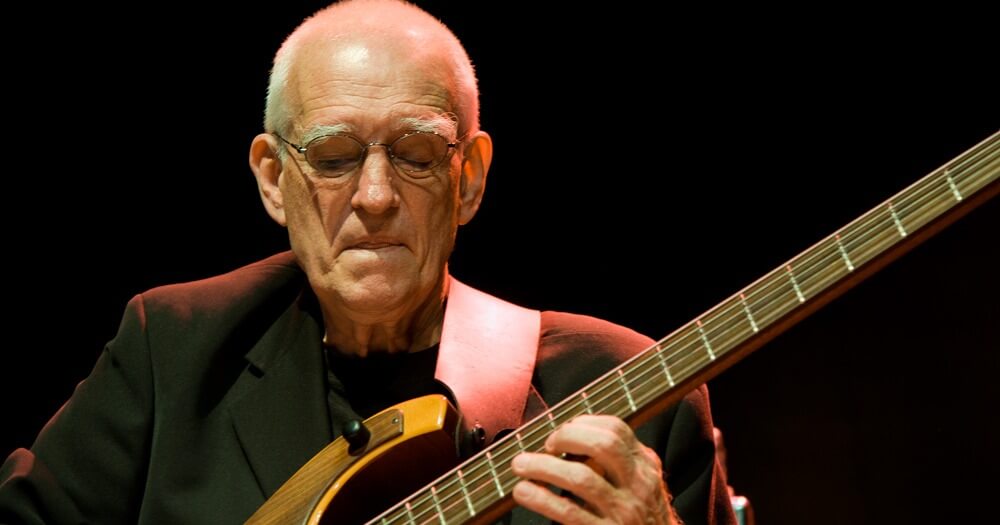
The man who gave everything to music, until he was saved by it—Steve Swallow's 'Winter Songs'
What can a musician give to music?
Technique, time, experience, emotion, memory. For someone who has dedicated a large part of their long life to performance and composition, the answers are countless.
Conversely, what can music give back to a musician?
'Winter Songs,' released by 85-year-old jazz bassist Steve Swallow, quietly answers that question.
This is his first full-fledged leader album in 13 years since 2013's 'Into The Woodwork.' It contains nine tracks, all titled simply from "One" to "Nine." There are no words to explain events or emotions, and no specific stories are given to any of the tracks.
However, it is not that nothing is being said.
Rather, by not placing words, the sound itself begins to speak volumes. The sway of the melody, the distance between instruments, the break in phrases, the space left after the sound fades. Each of these conveys the texture of time lived with loss.
'Winter Songs' is not a work that confesses sadness.
It is a work to breathe again with sadness.
To fill a day that is too long
Behind this album lies a significant loss for Swallow.
Composer and pianist Carla Bley was a musical ally for decades and also a life partner. Swallow participated in many of her works, continually supporting her unique compositional world. The two expanded the boundaries of jazz while building a relationship of deep mutual understanding in music.
After losing Bley, Swallow's daily life changed drastically.
Where once time was filled with conversation and collaboration, long voids appeared. How to spend a day, what to use as a clue to move on to the next day. It was then that Swallow began writing new songs.
He has said about this work that he needed to do something to fill the long days, and music came forward to support him.
Throughout his previous life, he had been giving what he had to music. But in the process of creating 'Winter Songs,' that relationship reversed. This time, it was the music that gave him what he needed.
And he expressed that music is as fundamental as the air we breathe.
These words are not merely a beautiful metaphor.
It is the realization reached by someone who has lived with music for over half a century, after experiencing a great loss in life. Music has become an environment necessary for living, not just a profession or a commodity for gaining recognition.
The quietness that pervades 'Winter Songs' is not one of resignation.
It is the calm breath of someone who has realized that something still exists to support them.
The companions gathered for the first leader work in 13 years
The album was recorded in September 2024 at Sear Sound in New York.
The members include trumpet player Mike Rodriguez, tenor saxophonist Chris Cheek, guitarist Steve Cardenas, pianist Gil Goldstein, drummer Adam Nussbaum, and Steve Swallow on electric bass and composition for all tracks.
What is important here is not just gathering excellent performers, but the gathering of trusted companions who have been involved with Swallow and Carla Bley for many years.
Swallow himself explained that this recording was born from a spontaneously formed community.
It wasn't just the performers. Engineers, piano tuners, those who brought meals, hotel receptionists. Many people, even those who did not leave a direct sound in the recording, supported the work.
This sense is reflected in the album's performance.
No one person steps forward to dominate the whole. Each player has a different role, offering sound at the necessary moment, and quietly stepping back when their role is complete.
Rodriguez's trumpet and Cheek's saxophone richly color the melody but do not push the song with excessive heat. Cardenas' guitar and Goldstein's piano do not layer chords thickly but leave space for each other's sound to resonate.
Nussbaum's drums do not just drive the performance with a strong beat. They adjust the time so that the entire music can naturally expand and contract without fixing the beats too much.
And Swallow, at the center, does not flaunt his leadership.
His bass is the foundation that supports everyone, but sometimes it plays the melody and starts a conversation at the same level as other instruments. When direction needs to be shown, he steps forward, but when his companions start speaking, he yields space so their words can be heard.
A great leader is not always the person who makes the loudest sound.
It is the person who creates an environment where everyone can speak in their own voice.
The figure who transformed the electric bass into a "singing instrument"
Steve Swallow is one of the performers who significantly changed the role of the electric bass in modern jazz.
In the early 1960s, he collaborated with Jimmy Giuffre and Paul Bley, participating in jazz that was cutting-edge at the time, where quietness and free dialogue coexisted.
Initially, he played the double bass, but through his activities with Gary Burton, he transitioned to the electric bass. Afterward, he collaborated with Carla Bley, Paul Motian, and John Scofield, expanding the language of jazz.
Swallow's characteristic is that he does not treat the electric bass as merely a low-pitched instrument.
Generally, the bass is responsible for supporting rhythm and harmony from below. However, Swallow's sound does not remain in the low register. With a soft, rounded tone, it moves to higher registers and sometimes sings melodies like a guitar or wind instrument.
However, he does not step forward to show off his technique.
No matter how freely he moves, he never loses sight of the structure of the entire piece. He understands not only how his sound is heard but also how the ensemble as a whole changes with his sound.
Swallow once learned from Jimmy Giuffre that composing is not enough just to write attractive melodies or appropriate chords; it is necessary to open a "field of possibilities" for improvisers.
The nine tracks included in 'Winter Songs' also inherit that philosophy.
The pieces are not blueprints that bind the players. On the other hand, they are not blank slates where anything goes.
They are maps that gently indicate the direction while leaving multiple paths for performers to discover themselves.
Track titles without words, from "One" to "Nine"
The fact that all nine track titles are just numbers is a significant feature of this work.
In general, a track title provides an entry point to the story for the listener. If there are words like "snow," "farewell," "night," or "memory," they will likely try to understand the music according to those meanings.
However, 'Winter Songs' avoids such explanations.
Swallow is said to have considered the possibility that titles with words might distract from the music itself. Having experience setting music to the poetry of Robert Creeley, he is well aware of the seductive and directive power of words.
That is why he left only numbers this time.
"One" begins as a gentle blues that opens the album's door. The piano and guitar quietly create a landscape, and the bass outlines the melody. Even when the horns join, the emotions do not suddenly surge.
In "Two," the piano and bass create a light waltz feel, with the tenor saxophone moving softly above it. While there is an intimacy reminiscent of past piano trios, it does not become mere nostalgia.
"Three" is a piece like viewing a painting. The melody does not head toward a clear conclusion but appears repeatedly, changing shape. The piano and guitar do not encroach on each other's territory but depict the same scenery from different angles.
In "Four," the same note changes meaning many times within different chords. Behind the familiarity, a slight unease and melancholy remain.
In "Six," the band swings powerfully. However, it does not rise intensely to overwhelm the listener. The horn players maintain enough heat without disrupting the balance of the performance.
In the latter half, "Seven" features lines of guitar, piano, and bass approaching and receding while conversing. "Eight" sounds as if it hides anxiety and tension beneath a calm surface.
And the final "Nine" is a ballad close to a whisper.
The trumpet sound does not declare a conclusion but slowly melts into the chords of the guitar and piano. It ends not as if the story concludes but as if the music quietly fades out of view.
The pieces appear and then disappear
One point noted in multiple reviews is that the tracks in this work seem to suddenly appear and disappear without sufficient explanation.
Short motifs are repeated, and they seem to develop into a large song. However, just before reaching a complete form, they move to another place.
This structure is similar to the workings of memory.
When recalling past events, they do not always replay as a complete story from start to finish. Short conversations, the light in a room, someone's expression, a familiar sound. Only fragments suddenly appear, linger in the mind for a while, and then fade away again.
Sadness is the same.
It does not end with a single cry. It does not disappear after a day of overcoming it. It appears unexpectedly in daily life, changes shape, and fades away before you know it.
The tracks in 'Winter Songs' have such a flow of time.
Because they do not strongly indicate a beginning and an end, the listener temporarily resides in that time rather than just appreciating the piece.
Breathing with grief, without explaining it
Works set against a backdrop of loss sometimes come with strong emotional expressions.
Tears, despair, anger, dramatic release. Sometimes the work demands clear emotions from the listener.
However, 'Winter Songs' does not magnify sadness.
Grief does not appear as intense sound at the forefront but exists as the tempo of the performance, the brevity of phrases, and the silence left between sounds.
Music does not resolve sadness.
Swallow is not declaring that he has completely overcome his loss. He is merely creating a place where people can start breathing again in their daily lives while holding onto that emotion.
This restraint does not weaken the emotion of the work.
Rather, it resonates deeply because it does not over-explain.
In significant moments of life, sometimes one is saved more by someone who sits silently beside them than by eloquent encouragement. The ensemble of 'Winter Songs' is close to such a presence.
When someone is playing, other performers do not fill the space with sound.
If a phrase is interrupted, that interruption is also embraced as part of the music.
Therefore, this work, while being jazz, has an intimacy akin to chamber music. The freedom of improvisation is maintained, but that freedom is not about playing as one pleases.
##