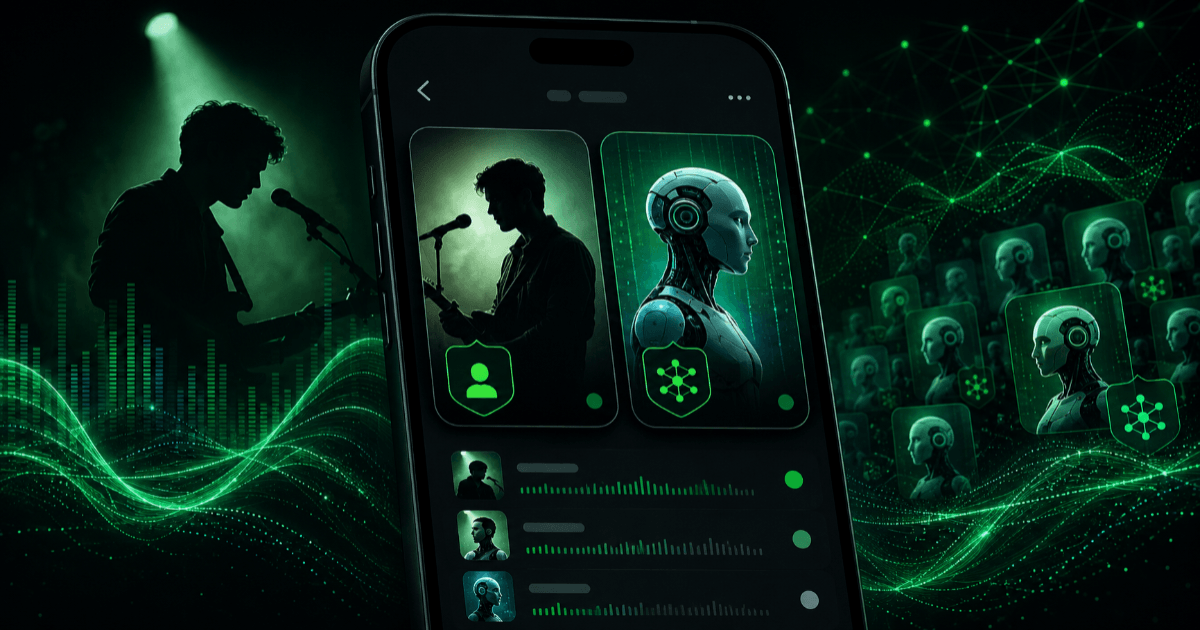
Spotify Finally to Label AI Artists
In the world of music streaming, the question "Does this artist really exist?"—a question that would have been unthinkable a few years ago—is becoming a reality.
Spotify, one of the world's largest music streaming services, is introducing a new label called "AI Persona" to help users identify artist personas created by AI.
The launch is scheduled for mid-September 2026.
Artists affected will have a display on their profiles indicating the possibility that they are not real humans but AI-generated personas or characters.
Moreover, the change is not just about adding a small mark to the profile screen.
According to Spotify, the AI Persona label will appear not only on artist profiles but also in various places where users interact with artists, such as search results and song displays within playlists.
Even more significant is the impact on the recommendation system.
Songs by artists treated as AI Personas will, in principle, be excluded from Spotify's editorial recommendations and algorithm-based recommendations generated for individual users.
In other words, Spotify has taken a step beyond merely "displaying that it is AI" and has decided to "distinguish between human artists and AI personas in recommendations."
This policy is likely to be a major turning point for music services in the era of generative AI.
The Surge of "Non-Existent Artists" in the Background
In recent years, the barriers to music production using generative AI have dramatically lowered.
Previously, music production required many processes, including songwriting, composing, arranging, performing, singing, recording, and mixing.
However, nowadays, services that can generate songs with vocals in just a few minutes based on text instructions are not uncommon.
Furthermore, using image-generating AI, one can create artist photos, and with text-generating AI, one can prepare profiles and fictional biographies.
Songs, singer's face, name, biography, album cover.
Creating all of these with AI makes it technically feasible to introduce a "new artist" on the internet who does not exist in reality.
The problem is that there are increasing cases where users listen to music without knowing this fact.
The profile photo shows a person with a natural expression, and the artist's name looks like a regular human name. The music is almost indistinguishable from typical pop, rock, country, Lo-Fi, or R&B.
However, upon investigation, there are no records of live performances, no personal social media, and no interviews.
Ultimately, there are cases where "the person did not exist in the first place."
Apart from the quality of the music itself, for listeners who thought they were supporting a human artist, this becomes a matter of trust.
What Spotify is particularly emphasizing this time is this transparency regarding "who is making the music."
Not a Label for All "AI-Created Songs"
There is a very important point to understand about this new system.
"AI Persona" is not a simple "AI music label."
What Spotify is primarily trying to determine is not the production process of the songs but the "persona" presented as the artist.
For example, suppose a real human musician uses AI to generate ideas during production.
Or suppose AI is partially used for voice processing, mastering, instrument sound generation, or lyric assistance.
In such cases, using AI does not immediately make it an "AI Persona."
Conversely, if something appears to be a real human singer on the profile but is actually a fictional entity created by generative AI, it may be subject to this label.
In other words, Spotify is trying to separate
"whether AI was used"
from
"whether the artist themselves is a real person."
This is an extremely important concept for the future of the music industry.
As generative AI becomes established as a production tool like DAWs and plugins, classifying all works that used AI even slightly as AI music will become unrealistic.
Therefore, it is believed that Spotify first focused on the relatively easier-to-judge "identity of the artist."
Not Relying Solely on Self-Declaration
There is another feature of the AI Persona system.
Spotify provides artists with a mechanism to voluntarily declare if their profile is an AI Persona.
However, not everyone will necessarily declare honestly.
Some operators might think it's easier to attract attention as a human new artist by hiding the fact that they are AI.
Therefore, Spotify does not rely solely on self-declaration and conducts its own review.
If it is determined that names or images on the profile use realistic AI-generated individuals, Spotify will assign the label.
Initially, the policy is to prioritize checking profiles viewed by a significant number of users, starting with those with a large impact.
If Spotify's review determines the possibility of an AI persona, the artist will be notified and given the opportunity to appeal.
In the future, there are plans to introduce a feature that allows listeners themselves to report "Isn't this profile an AI persona?"
Since the perfection of AI detection is not guaranteed, this appeal system becomes important.
A System Inextricably Linked with "Verified by Spotify"
Spotify did not suddenly start AI countermeasures this time.
In April 2026, they announced a certification system called "Verified by Spotify."
This system, conversely, is designed to confirm "that the artist is real."
In addition to continuous listener activity and healthy activity on the platform, Spotify also considers information that shows the artist is actually active, such as live information, merchandise, and external social media.
According to Spotify, they are advancing certification to cover more than 99% of artists actively searched by listeners.
In retrospect, this is an interesting change.
In traditional music services, it was an implicit assumption that "the artists listed there are human."
However, the advent of generative AI has shattered that assumption itself.
Therefore,
"This person is real"
"This person is an AI persona"
Both directions of proof are starting to become necessary.
In the online society, identity verification has been conducted as a countermeasure against fake accounts on social media.
In the future, even in music services, being human itself may become part of the profile information.
Another Issue: Mass Production of AI Music
The issues surrounding AI music are not limited to the identity of the artist.
With the cost of generation becoming extremely low, it is now possible to create a large number of songs and upload them to streaming services.
A study on AI music streaming released in June 2026 found that the overwhelming majority of AI music surveyed was rarely played or recommended, while some creators were observed to be targeting hits by releasing a large number of songs across multiple genres.
The study analyzed mass submissions using AI as a structure similar to existing internet spam.
This is not unrelated to human artists.
A vast number of new songs are released daily on streaming services.
If a large number of AI songs with almost no production cost are added, it could take away the opportunity for human artists to be discovered by new listeners.
Furthermore, if fraudulent plays and mass submissions are combined, it could lead to issues regarding royalties.
Spotify has also been strengthening its countermeasures against "music spam," which includes mass uploads, duplicate content, posts targeting search rankings, and extremely short songs.
The decision to exclude AI Personas from recommendations in principle is an extension of this trend.
"Finally Here" Voices on Social Media
The announcement has already sparked various opinions on social media and online communities.
Particularly noticeable are voices evaluating the approach of not banning AI itself but making it clear that it is AI.
In a Reddit community where Spotify artists gather, reactions have been posted with the sentiment that "it's okay to use AI, but it shouldn't be made to look like a human."
The issue with AI content is not necessarily AI itself but the idea that "hiding the true nature" is the problem.
In another Spotify-related community, users who dislike low-quality content generated in large quantities being included in playlists or recommendations have welcomed this change.
There are also voices with nuances like "Finally addressed" and "A step forward," indicating that at least the direction of increasing transparency is being positively received by many.
On the Other Hand, Some Say "Labels Alone Are Not Enough"
However, not all users are satisfied.
In Reddit's technology-related community, there are opinions expressing a desire for a setting that completely hides AI works.
In other words,
"It's enough if you make it clear that it's an AI Persona"
and
"I don't want AI music to appear on my screen at all"
are two different user perspectives.
This time, Spotify has indicated a policy of excluding AI Personas from recommendations in principle, but it does not completely prohibit searches or remove them from the platform.
Users who want to listen to AI artists can search and listen on their own.
This shows that Spotify is not trying to ban AI music itself.
What Spotify is trying to create is
"a place where AI music cannot exist"
but rather
"a place where you are less likely to listen without knowing it's AI."
This difference is significant.
From AI Creators: "Where Does AI Persona Start?"
Another issue emerging on social media is the boundary problem.
One music creator posted a question about whether they would be treated as an AI artist if they used vocal material generated from AI software in their production.
The range of AI use in current music production is very broad.
Vocal generation.
Noise removal.
Pitch correction.
Lyric assistance.
Chord progression suggestions.
Drum pattern generation.
Sound design.
Mixing and mastering.
Jacket creation.
Promotion text creation.
If AI is involved in any one of these, does it make you an AI artist? The line becomes almost impossible to draw.
That's why Spotify bases the AI Persona on "who the profile represents" rather than "how the song was produced."
It distinguishes between cases where humans use AI as a tool and cases where AI itself is marketed as a fictional artist.
This way of thinking may be referenced in creative industries beyond music in the future.
Concerns About "Being Misjudged"
On the other hand, AI judgment always comes with the problem of false detection.
Human artists using unique CG images in their profiles.
Music projects that operate solely with fictional characters without showing faces.
Virtual artists.
Anonymous artists.
VTuber-style music activities.
Characters co-constructed by humans and AI.
It is difficult to simply divide these into "real person" and "AI persona."
On social media, there are posts questioning how accurately Spotify can actually distinguish these.
As the quality of AI images improves, it may become impossible for even humans to judge.
Conversely, there is a non-zero possibility of mistakenly identifying human artists intentionally using CG-style visuals as AI.
Spotify's preparation of an appeal system likely anticipates such issues.
Once the system is fully operational, attention will be paid to how many cases of "judged as AI Persona but actually human" occur.
Doubts About Spotify Itself
There are even harsher views on social media.