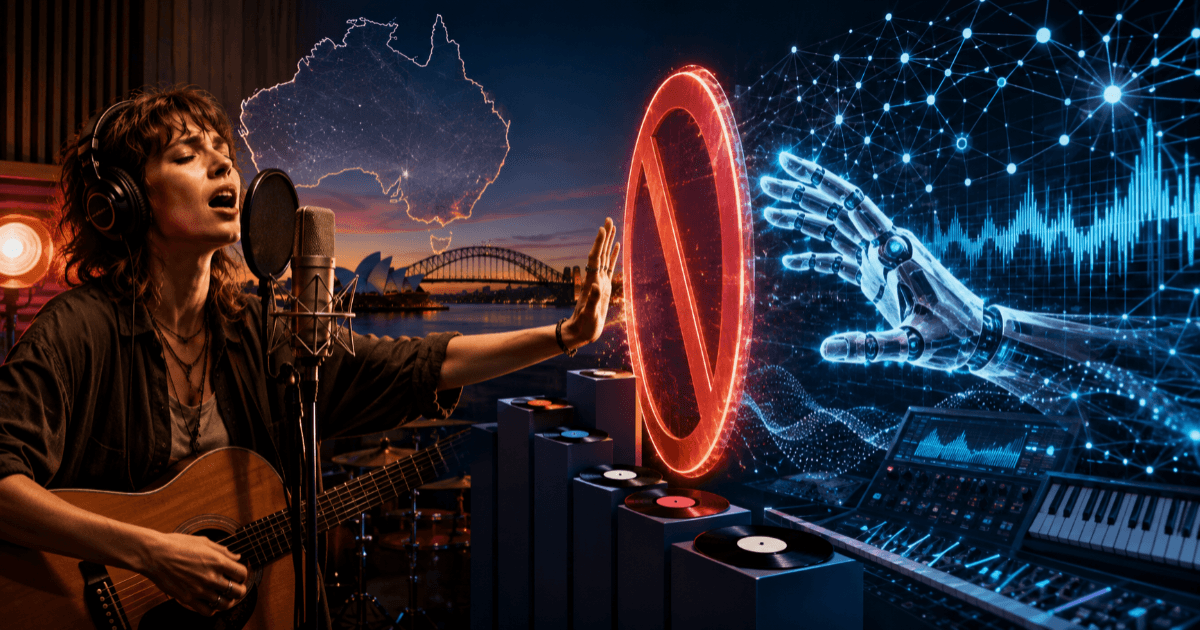
If we listen to music and think "this is a great song," but later find out that the singer doesn't actually exist, can we still evaluate the song in the same way?
With the rapid evolution of generative AI, such questions are no longer just hypothetical but are becoming a reality in the music business.
The Australian Recording Industry Association (ARIA) has introduced new rules excluding songs primarily created by generative AI from official charts.
Importantly, this is not a simple decision to ban music created using AI.
ARIA is drawing a line not based on whether AI was used as a tool, but on whether human creation is at the core of the work.
This distinction could have significant implications for the Japanese music industry as well.
AI Songs Disappear from Charts
Under ARIA's new approach, if generative AI creates the entirety or the main creative parts of a song, the work is categorized as "AI-Generated."
For example, songs where AI generates the lead vocals, important instrumental performances, or where the majority of the song is created by simply inputting prompts fall under this category.
On the other hand, works where humans are central to the lyrics, composition, performance, and singing, with generative AI used in part of the production process, are treated as "AI-Assisted."
This means that the system does not uniformly exclude AI noise reduction, sound quality correction, or idea generation in production. What ARIA aims to protect is not "music without AI" but "music created primarily by humans."
This will become an important concept for the entire creative industry moving forward.
In various fields such as illustrations using image-generating AI, novels utilizing text-generating AI, and videos incorporating AI editing, it is no longer possible to classify works simply by whether AI was used or not.
The issue is shifting towards who makes the final creative decisions and whose intentions and expressions are reflected in the work.
The Catalyst: "Like a Prayer"
An event symbolizing this rule change was the cover of Madonna's classic "Like a Prayer" by Australian DJ and music producer Josh Fawaz.
The song was heavily broadcast on Australian radio and became the most played song on national radio airplay by July 2026.
It also ranked high on several ARIA charts, becoming a major hit in Australia.
However, as the song's popularity grew, questions about "who is singing" arose on social media and within the music industry.
It was later revealed in the Spotify credits that AI-generated vocals and AI drums were used. In other words, the crucial parts of the singing voice that many listeners might have thought were performed by a human singer were actually created by AI.
The issue raised by this event is not just about sound quality or technology.
It was a question concerning the very meaning of the charts: "Is it fair to have human artists compete against AI-generated works on the same ranking?"
Traditionally, hit charts have been indicators of "the most listened-to music in society" and a stage for evaluating the achievements of artists, lyricists, composers, performers, and producers.
However, if AI, capable of generating a large number of works in minutes to hours, joins the same arena, the traditional meaning of "a ranking that evaluates human creative activity" becomes unstable.
90,000 Songs a Day—AI Music Has Surpassed the "Experimental" Stage
The reason discussions about AI music are rapidly gaining realism is due to its supply volume.
In July 2026, music streaming service Deezer announced that approximately 90,000 songs deemed fully AI-generated were delivered daily, accounting for more than 50% of new uploads at peak times.
We are no longer at the stage of "AI music might increase in the future."
On some platforms, there are already days when more than half of the newly delivered songs are AI-generated.
However, there are also intriguing numbers.
According to Deezer, the proportion of AI-generated songs in actual total plays is only about 1-3%. Additionally, up to 85% of AI song plays were detected as fraudulent streaming.
In other words, "a large number of AI songs being created" does not necessarily mean "humans want to listen to a large amount of AI music."
As generation costs plummet, music becomes not just "works" but also "data that can be mass-produced."
If one person can generate hundreds or thousands of AI songs a day and automatically distribute them to streaming services, an unprecedented volume of content will flood the market.
Moreover, if combined with autoplay and bot-driven play count manipulation, it becomes difficult to distinguish between works genuinely supported by people and those with inflated numbers on the system.
ARIA's concern about AI songs is not only about "human creation" but also about the potential for streaming and chart manipulation.
The Global Music Industry Shifts from "Ban" to "Labeling"
At first glance, ARIA's decision might seem like the global music industry is trying to exclude AI music.
However, the movement is a bit more complex.
In July 2026, multiple music and creator-related organizations, including the International Federation of the Phonographic Industry (IFPI), RIAA, A2IM, WIN, IMPALA, Grammy-related organizations, and SAG-AFTRA, announced a policy to introduce a common labeling method for sound sources using generative AI.
The approach of distinguishing between "AI-Generated" and "AI-Assisted" is adopted there as well.
Thus, the emerging global direction is not to "erase all works using AI."
Instead, it aims to clarify the extent of AI involvement, creating an environment where listeners can ultimately make their own judgments.
Spotify also announced in mid-September 2026 that it would introduce "AI Persona" labels to some artist profiles.
This label indicates the possibility that an artist appearing human on the profile is actually a fictional character created by AI, rather than showing whether the song itself is AI-generated.
Furthermore, Spotify has indicated that, in principle, songs by AI Personas will not be included in editorial recommendations or algorithmic suggestions unless users actively show interest in following the artist.
This marks a significant change.
Previously, on streaming services, if the music was good, one could listen without thinking deeply about "who is singing."
However, in the AI era, information such as "Does this artist exist?", "Is this voice human?", and "How much of this song was created by AI?" is starting to become a factor in choosing works.
Just like checking ingredient labels on food, it might become standard in the future for music to display "production processes."
Welcoming Voices on Social Media, but "How to Define the Boundary?"
On social media and online communities, there are notable voices welcoming ARIA's decision.
In the Australia-related Reddit community, responses such as "It's a natural response," "It should have been introduced sooner," and "Necessary to protect musicians' jobs" have been shared.
More interesting, however, is the question of "how to distinguish between fully AI-generated and AI-assisted."
Discussions are spreading, such as "Can you chart if you use AI just a little?", "Is AI mixing okay even if AI vocals are not?", and "What if only the lyrics are AI-generated?"
In modern music production software, features applying AI and machine learning, such as noise reduction, pitch correction, stem separation, and mastering support, are rapidly becoming common.
Therefore, on social media, there are also comments pointing out that a simple rule of "banning anything using AI" would make real music production unfeasible.
In July 2026, a discussion was also held in an overseas Reddit community dealing with J-POP about whether AI-generated music should be banned within the community, with many users supporting regulation.
This is not a domestic Japanese public opinion survey but merely the reaction of an online community of J-POP fans. However, it reflects a strong caution against human artists' works being buried due to the mass posting of AI works.
Judging from the discussions on social media, what many people dislike is not the AI technology itself, but rather "AI works being distributed as if they were human creations without disclosure" and "mass-produced works overwhelming human creators."
Japan's Unique Situation with "Vocaloid Culture"
Considering the Japanese music market, the situation is slightly different from Australia.
In Japan, VOCALOID culture, including Hatsune Miku, has developed over many years.
Creating music using non-human voices is not a new phenomenon.
In fact, in Vocaloid culture, the value of a work has been recognized more in terms of what melodies, lyrics, tuning, visuals, and worldviews composers and Vocaloid producers create, rather than "who is singing."
This is why it is important not to confuse generative AI music with traditional voice synthesis culture.
The structure of human creative involvement is entirely different between works where humans input each note, create melodies, write lyrics, and finely adjust singing, and works where AI generates most of the song by inputting something like "an '80s J-POP-style breakup song with female vocals."
ARIA's rules focus not on whether mechanical voices or digital technology are used, but on "who created the main creative parts."
This approach is relatively compatible with Japanese music culture.
JASRAC Also Uses "Human Creative Contribution" as a Criterion
In fact, a similar approach already exists in Japan.
In its updated 2026 guidelines on "Handling Works Using AI," JASRAC states that it will manage works using AI if "human creative contribution" is recognized.
Conversely, it will not manage lyrics or music autonomously generated by AI based on simple instructions, as they do not qualify as copyrighted works due to the lack of human creative contribution.
Furthermore, it provides specific handling for cases where AI and human creation are mixed, such as when only the lyrics are AI-generated and the music is created by humans.
Of course, JASRAC's guidelines concern copyright management, which differs from ARIA's chart eligibility.
Nonetheless, both share the commonality of prioritizing "the extent of human creation" as a crucial criterion, rather than the formality of "using AI."
This will likely serve as an important hint when considering AI music rules in Japan in the future.
The Same Issue Will Come to Japan's Music Charts
In Japan, it has become common for unknown artists to achieve major hits in a short time, thanks to streaming, YouTube, and TikTok.
This was a significant change in terms of democratizing the music industry.
Even without a record label contract, individuals can now deliver music to the world.
Generative AI will further accelerate this trend.
The era is coming where you can create music with just an idea, even if you can't play instruments, aren't good at singing, or can't afford an expensive studio.
In that sense, AI music has the potential to create new creators.
However, as production costs approach zero, there is a risk of it becoming a game of "whoever produces the most wins."
If a human artist takes six months to produce a 10-track album, while a business using AI can distribute 1,000 songs a day, it becomes difficult to maintain fair competition under the same rules as before.
If search results, recommendations, playlists, and rankings are filled with AI-generated content, the biggest impact might not be on famous artists but on new and indie musicians trying to gain fans.
Therefore, in Japan too, a simple discussion of "whether to include AI-generated songs in the charts" will not suffice in the future.
It is necessary to consider AI usage disclosure, countermeasures against streaming fraud, handling in recommendation algorithms, copyright, permission for sound sources used in AI learning, and revenue distribution as a whole.
The Question Is Not "AI or Human"
It is easy to view ARIA's decision as a conflict between "humans vs. AI."
However, looking back at the history of music, new technologies have always faced resistance but eventually became part of creation.
Synthesizers, sampling, drum machines, Auto-Tune, DAWs, Vocaloids. Many of these sparked debates about whether they were "real music" when they first appeared.
Generative AI will likely not disappear either.
What will become important is not "eliminating AI," but distinguishing between creation where humans use AI as a tool and systems where AI mass-produces works in place of humans.
Another crucial aspect is allowing listeners to make choices knowing the difference.
Some people want to listen to songs sung by humans, while others might find music by AI artists interesting.
There is even the possibility of an AI music-specific chart emerging.
That in itself is not a bad thing.
The problem arises when the fact that a work was created by AI is hidden, it competes under the same conditions as human artists, and rankings and revenue distribution are influenced by mass production and fraudulent plays.
What Australia has shown this time is not the final answer to music in the AI era.